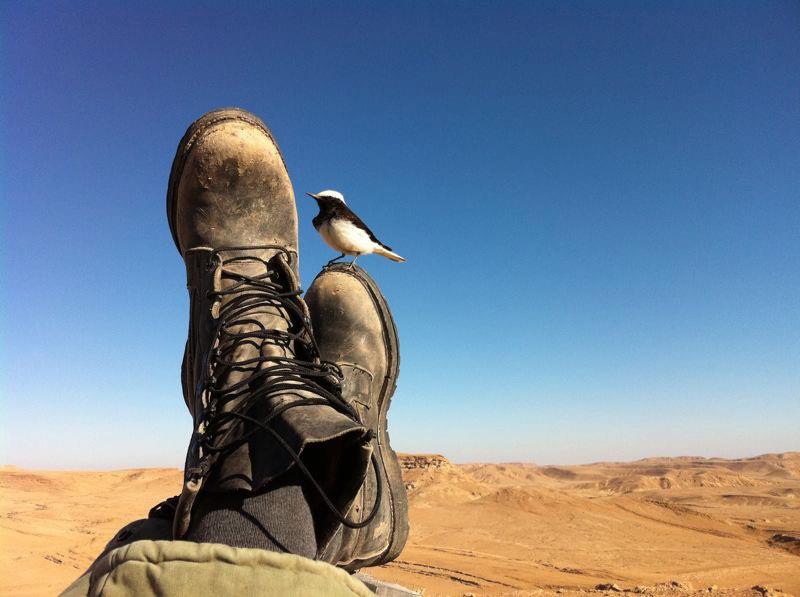
For anyone with even a passing interest in current affairs, the phrase ‘boots on the ground’ seems impossible to avoid. When discussing policy options for resolving conflicts in the Middle East, politicians and 24-hour news networks have embraced this expression to refer to the deployment of Western land forces in war-torn areas. Of course, boot-wearing soldiers have been trudging through mud since time immemorial, but this increasingly ubiquitous piece of military jargon has surprisingly recent origins.
British military officer and counter-insurgency expert Sir Robert Grainger Ker Thompson came close to employing the phrase in his 1966 book Defeating Communist Insurgency: Experiences from Malaya and Vietnam – chapter 15 was titled ‘Feet on the Ground’. In the book, Thompson posited that air strikes and artillery could not in themselves defeat guerrilla forces; victory required the physical presence of land forces to occupy and police conflict zones.
However, as William Safire noted in The New York Times in 2008, the precise expression did not appear in print media for another fifteen years.[1] In an April 1980 article in The Christian Science Monitor, American four-star general Volney Warner discussed the possibility of ‘getting U.S. combat boots on the ground’ to resolve the Iranian hostage crisis. Employing the term ‘boots’ as a metonym for military personnel was not novel; it had been used since the Second World War as slang for marine recruits, explaining the origin of the phrase ‘boot camp’ to refer to basic training.
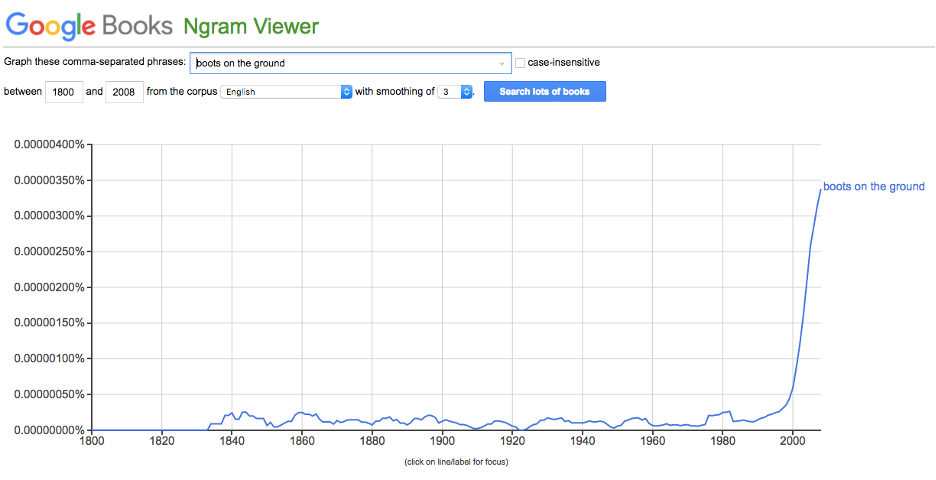
But as military jargon goes, ‘boots on the ground’ was something of a sleeper hit. A search of Google Books shows that the phrase only appeared in published works with its modern meaning from 1997. A Google n-gram chart (see below) likewise suggests that the expression entered common parlance at the end of the 1990s, gaining traction with the onset of the War on Terror. For instance, as American forces began a ground offensive in Afghanistan in October 2001, The Guardian quoted Defence Secretary Geoff Hoon mooting the possibility of British ‘boots on the ground’ as part of efforts to capture Osama bin Laden.[2] Similarly, in 2004, the Associated Press reported that President Bush had approved the request of his military commanders for ‘more boots on the ground’ to help secure Iraqi elections.[3]
Perhaps not surprisingly, the phrase has become increasingly controversial and politicized as its popularity has grown. In contrast to no-fly zones, airstrikes, and providing military aid to local forces, putting ‘boots on the ground’ involves placing Western soldiers directly in harm’s way – always a contentious proposition, and all the more so in the wake of drawn-out deployments in Iraq and Afghanistan. James Wright took issue with the expression in a 2016 piece in the The Atlantic, arguing that the focus on footwear ‘obscures and abstracts the humanity’ of soldiers sent overseas on dangerous combat missions.[4] The precise definition of ‘boots on the ground’ is also open to debate. Writing for The Guardian, Scott Beauchamp recalled the Obama administration’s contention that the phrase did not apply to special forces advisers sent to Syria in 2015.[5] Even though these advisers were presumably wearing military regulation footwear, the White House press secretary claimed that the President had not violated his 2013 pledge to avoid putting ‘boots on the ground’ in Syria, as the figure of speech, in Obama’s mind, referred only to ‘large-scale, long-term ground combat operations’, not to the limited deployment of specialists.
Strikingly, the metaphor has enjoyed considerable success beyond military and foreign policy circles. ‘Boots on the ground’ is now used in the context of political campaigns to refer to volunteers and grassroots support.[6] The expression even found a place in the titles of 2016 papers on archaeology and forestry management, in the latter case seemingly as a synonym for frontline workers.[7]
Perhaps echoing the fears of critics of indefinite overseas deployments, the phrase ‘boots on the ground’, having only recently parachuted into the lexicon, is by all appearances here to stay.
[1] William Safire, ‘Let’s Do This’, New York Times (7 November 2008). http://www.nytimes.com/2008/11/09/magazine/09wwln-safire-t.html?_r=2&&mtrref=en.wiktionary.org
[2] ‘US special forces attack Taliban in fierce firefight’, The Observer (21 October 2001), p. 1.
[3] ‘Bush: Iraqi vote must go on as scheduled’, The Item (3 December 2004), p. 8a.
[4] James Wright, ‘Remembering Those Who Wore the ‘Boots on the Ground’, The Atlantic (30 May 2016). https://www.theatlantic.com/politics/archive/2016/05/boots-on-the-ground/484682/
[5] Scott Beauchamp, ‘“Boots on the ground” and other military jargon are designed to confuse’, The Guardian (13 November 2015). https://www.theguardian.com/commentisfree/2015/nov/13/boots-on-the-ground-other-confusing-military-jargon-us-troops
[6] William Safire, ‘Let’s Do This’, New York Times (7 November 2008). http://www.nytimes.com/2008/11/09/magazine/09wwln-safire-t.html?_r=2&&mtrref=en.wiktionary.org
[7] K. Reese-Taylor et al, ‘Boots on the Ground at Yaxnohcah: Ground-Truthing Lidar in a Complex Tropical Landscape’, Advances in Archaeological Practice, Vol. 4, Iss. 3 (August 2016), pp. 314-338; ‘Boots on the Ground’, Journal of Forestry, Vol. 114, Iss. 2 (March 2016), pp. 178-183.
 1812 and all that
