I’m very pleased to share a new publication, “‘A natural passion?’: The 1810 reflections of a Yorkshire farmer on homosexuality”. It considers a diary entry by Matthew Tomlinson which made the news last year and appears in the journal Historical Research.
The article can be accessed via this link but requires a subscription. However, I am able and willing to share a PDF with anyone who wants a copy via email.
My research on Tomlinson’s diary entry has been a diversion from the main thrust of my PhD studies into military music, albeit a very fruitful one. I hope specialists in the history of sexuality find the resulting article stimulating and useful.
I gratefully acknowledge the Arts and Humanities Research Council for funding the doctoral research which led to this discovery. I thank Rictor Norton for his advice and encouragement as well as my supervisors Erica Charters and Bob Harris, Matt Pickles at the Oxford University Press Office and the staff at Wakefield Library, especially Claire Pickering. I am also grateful to Helen Craske, Fara Dabhoiwala, Matthew Grimley, Joanna Innes, Gerard Killoran, Seth LeJacq and the two anonymous reviewers of the article for their suggestions and contributions.
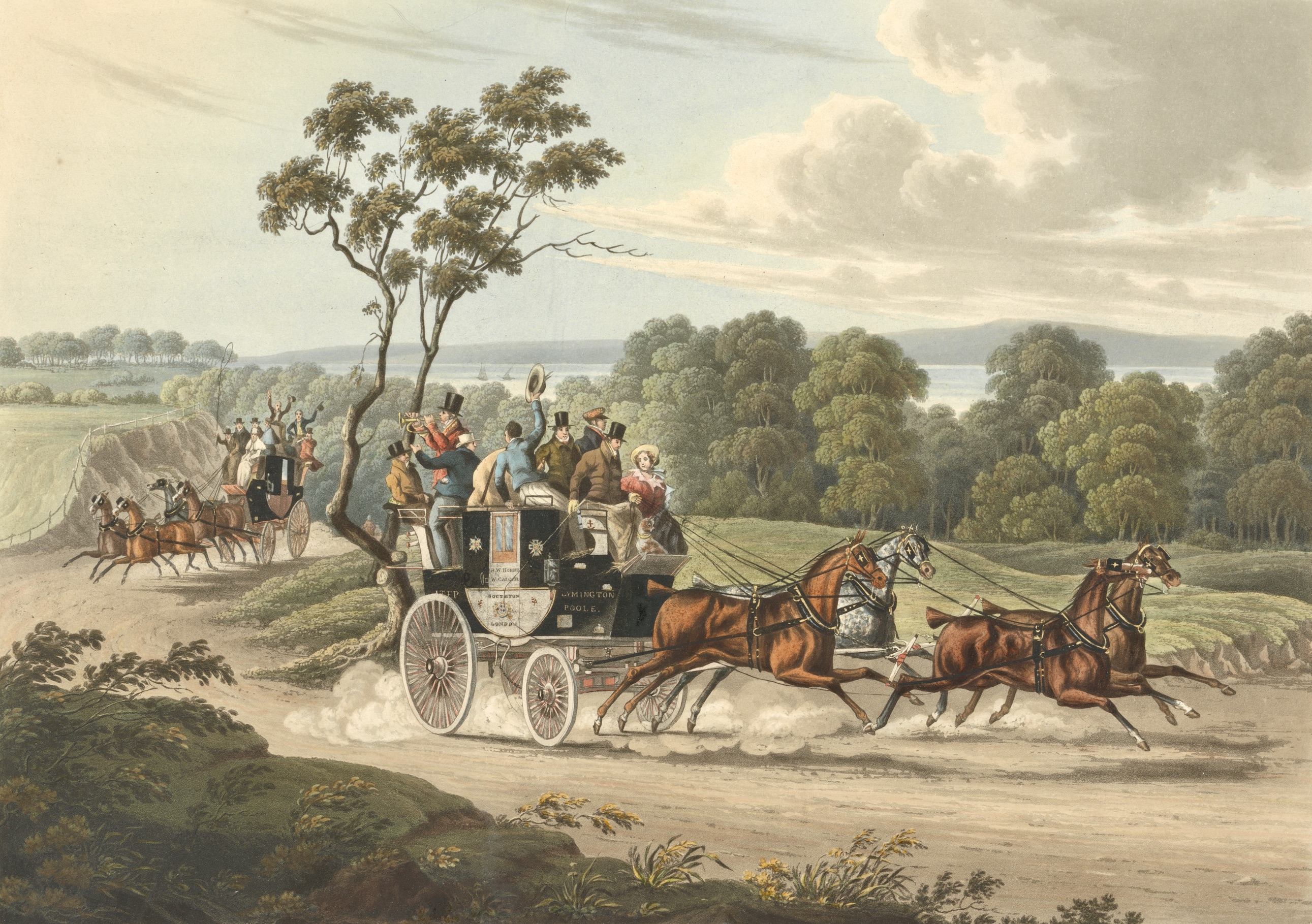
Opposition Coaches at Speed, 1832 (Yale Center for British Art)
The military was the largest single employer of professional musicians in late Georgian Britain and Ireland by a country mile. The armed forces considerably expanded opportunities for men and boys to acquire musical skills and, as Trevor Herbert and Helen Barlow have argued, stimulated innovations in instrument design.1
Instruments popularized by military musicians were widely employed in the amateur wind and later brass bands which proliferated in the decades after Waterloo, often comprised of working-class men under the direction of old soldiers. But the impact of military music-making on wider musical culture can also be discerned in more unexpected contexts – including the world of stagecoach transport.
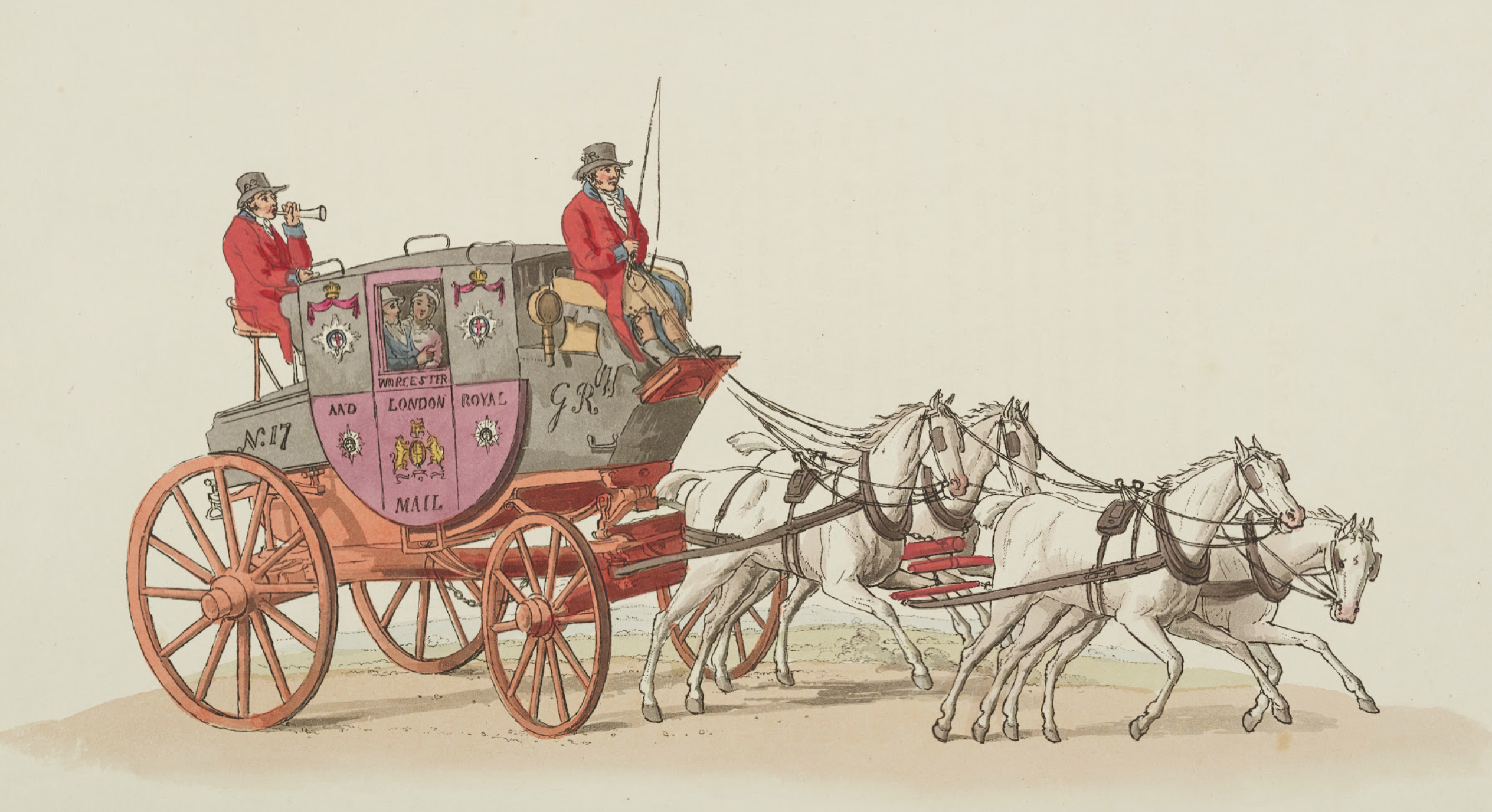
Aquatint depicting traditional tin post horn from ‘The Costume of Great Britain’ by W.H. Pyne, published by William Miller, 1805: Plate 54, Royal Mail Coach (Science Museum, London)
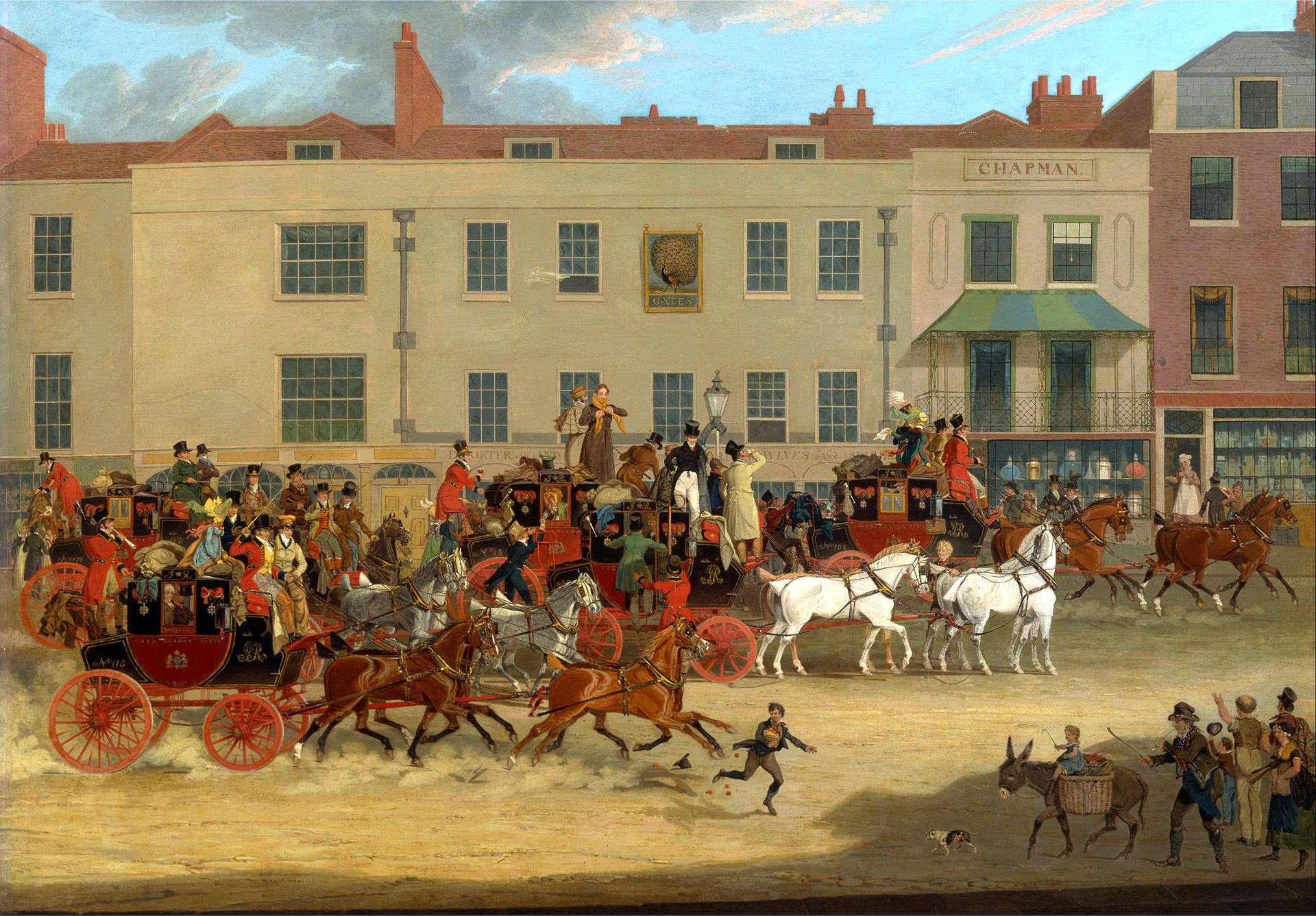
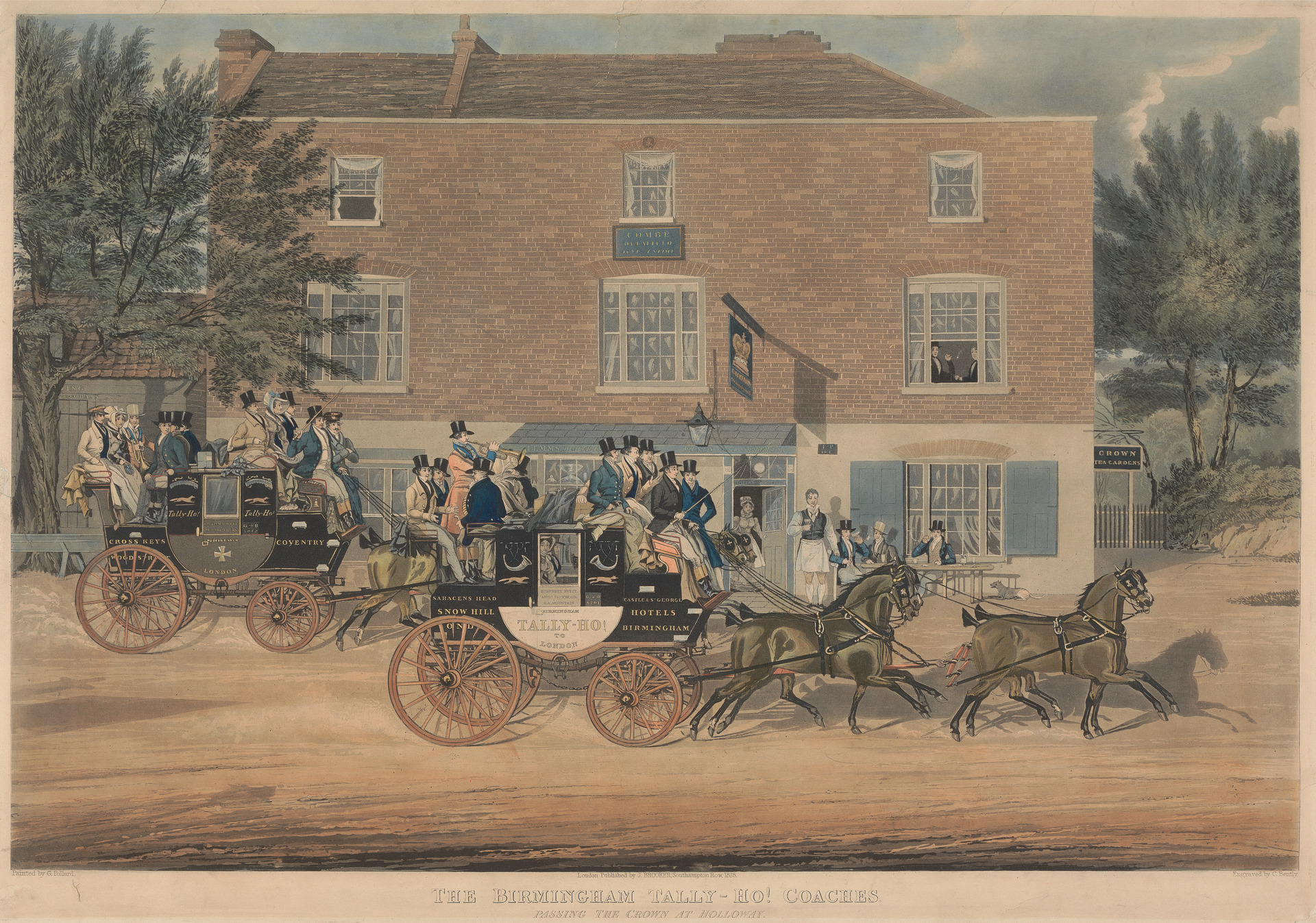
Red-coated coach guards had traditionally blown tin post horns to announce their arrival at inns or toll-gates, producing (according to one army officer) an unmelodious and ‘intolerable blast’.2 But these unsophisticated instruments were frequently cast aside in the post-war years in favour of the keyed bugle, which had been patented in 1810 by Joseph Haliday, the master of the band of the Cavan Militia, and rapidly adopted by myriad regimental ensembles thereafter.3 The keyed bugle boasted not only the requisite audibility but (unlike the ordinary bugle) a full chromatic range, allowing guards to entertain travellers with lively melodies on tedious journeys and thereby secure generous gratuities.4 Although musical competence among coachmen varied widely, able performers achieved considerable renown along their routes, drawing eager listeners ‘to the windows and doors of their houses’ as they played their way through the countryside.5 Musically-inclined coach guards were also acutely audible in late Georgian cityscapes, participating in civic processions and entertaining ‘very numerous’ audiences outside inns while waiting to depart. The London artisan and social reformer Francis Place, for example, described several guards joining in waltzes and ‘fashionable airs’ from their respective vehicles around Charing Cross on a sunny summer morning in 1827.6 Accomplished performances on the keyed bugle were an advertised selling point on some services, with knowledge of the instrument becoming a common job requirement for coach guards.7
Keyed bugle manufactured by Joseph Greenhill (St Cecilia’s Hall Music Museum, Edinburgh Acc. No. 3741)
Unsurprisingly, some of these musically-trained transport workers had honed their skills in the military. One coach guard, who ‘always attracted much attention’ by blowing his bugle through central Manchester, had previously served as a musician in the Grenadier Guards.8 Indeed, the keyed bugle craze among coachmen owed much to the enterprise of an old soldier, Joseph Greenhill, a London-based teacher and maker of the keyed bugle. Formerly the bugle-major of the Shropshire Militia and a virtuoso performer in his own right, Greenhill was reportedly the first to introduce Haliday’s new-fangled horns on coaching services. Having aggressively developed the market and manufactured thousands of bugles, he enjoyed a roaring trade catering to coach guards until his death in 1836.9
The coming of the railways undermined the coaching industry soon after, while new valved brass systems imported from the Continent, adopted and publicized by regimental bands and ex-servicemen such as John Distin, rendered Haliday’s instrument obsolete by the 1840s. Yet the cheery bugle solos of passing coachmen elicited considerable nostalgia from Victorian writers, and were even credited by one commentator in 1853 with better attuning ‘the ears of the masses’ to the correct musical scales.10 As the keyed bugle’s ubiquity in the coaching trade suggests, the technologies, repertoires and musical forms developed or inspired by martial musicians and armed conflict – from the brass band to the battle piece – were embraced and reimagined by civilians in contexts as disparate as radical political rallies and fashionable drawing rooms. The entrepreneurial spirit of Joseph Greenhill, moreover, was by no means atypical of discharged regimental bandsmen in the post-war decades. These men moved between civilian and military spheres with relative ease, carving out varied careers as street performers, amateur band leaders and retailers, developing controversial piano teaching methods and even making their mark as opera singers on the London stage. In music as in so many other areas, war and culture were intertwined: state and elite investment in military ensembles, combined with the ingenuity of individual ‘musical warriors’, spawned technological innovation and helped stimulate the nineteenth-century expansion of popular music-making.
Listen to a keyed bugle made by Joseph Greenhill, now held in the University of Edinburgh’s Musical Instrument Collection, in the video below:
Images: ‘North Country Mails at the Peacock, Islington’ by James Pollard, 1821 and ‘The Birmingham Tally-Ho! Coaches Passing the Crown at Holloway’, 1828 (Yale Center for British Art)
1 T. Herbert and H. Barlow, Music and the British Military in the Long Nineteenth Century (Oxford, 2013), p.85. Wartime coachmen had occasionally experimented with more sonorous alternatives, not always with felicitous results: a guard on the Derry mail coach in 1810 delighted passengers by playing the clarinet but was thrown from the roof and killed instantly. See J. Gamble, Society and Manners in Early Nineteenth-Century Ireland, ed. B. Mac Suibhne (Dublin, 2011), p.179.
2 Journal of an Officer in the King’s German Legion… (London, 1827), p.41.
3 R.T. Dudgeon, The Keyed Bugle, 2nd edn (Lanham, MD, 2004), pp.14-16; J.B. Logier, Logier’s Introduction to the Art of Playing on the Royal Kent Bugle (Dublin, [1813]), p.5.
4 Dudgeon, The Keyed Bugle, p.34; Morning Post, 27 September 1825; United Service Journal (February 1837), p.198.
5 [H.E.] Malet, Annals of the Road or Notes on Mail and Stage Coaching in Great Britain (London, 1876), p.44; J. Cossins, Reminiscences of Exeter fifty years since (Exeter, 1877), p.54.
6 F.E. Witts, The Complete Diary of a Cotswold Parson: The Diaries of the Revd Francis Edward Witts, ed. A. Sutton (10 vols, Chalford, 2008), vol. iv, p.188; Malet, Annals of the Road, p.41; United Service Journal (May 1837), p.70; British Library, Add MS 27828, Francis Place: Collections on manners and morals, vol. iv, 25 July 1827, p.7.
7 Western Times, 13 August 1842; Bell’s Life in London and Sporting Chronicle, 31 January 1836; Freeman’s Journal, 5 May 1836.
8 J.T. Slugg, Reminiscences of Manchester Fifty Years Ago (Manchester, 1881), pp.212-213.
9 D. Lasocki, ‘New Light on the Early History of the Keyed Bugle, Part 2: More on England and Ireland; The United States’, Historic Brass Society Journal, 22 (2010) pp.22-23; Morning Advertiser, 16 August 1827; Bell’s Life, 31 January 1836; Morning Advertiser, 2 April 1836.
10 Musical Times, 1 March 1853, p.149; C.T.S. Birch Reynardson, ‘Down the Road’, or, Reminiscences of a Gentleman Coachman, 2nd edn (London, 1875), p.208.
Friends and followers may be interested to know that I will be appearing on Songs of Praise on BBC One tomorrow (Sunday 27 September) at 1.15pm UK time to share my research on the Georgian diary of Yorkshire farmer Matthew Tomlinson. Here’s a clip from the episode about his fascinating reflections on homosexuality:
I hope my readers are faring as well as can be expected during the current lockdown. I am holed up in Oxford at the moment, working on writing up a chapter for my PhD thesis.
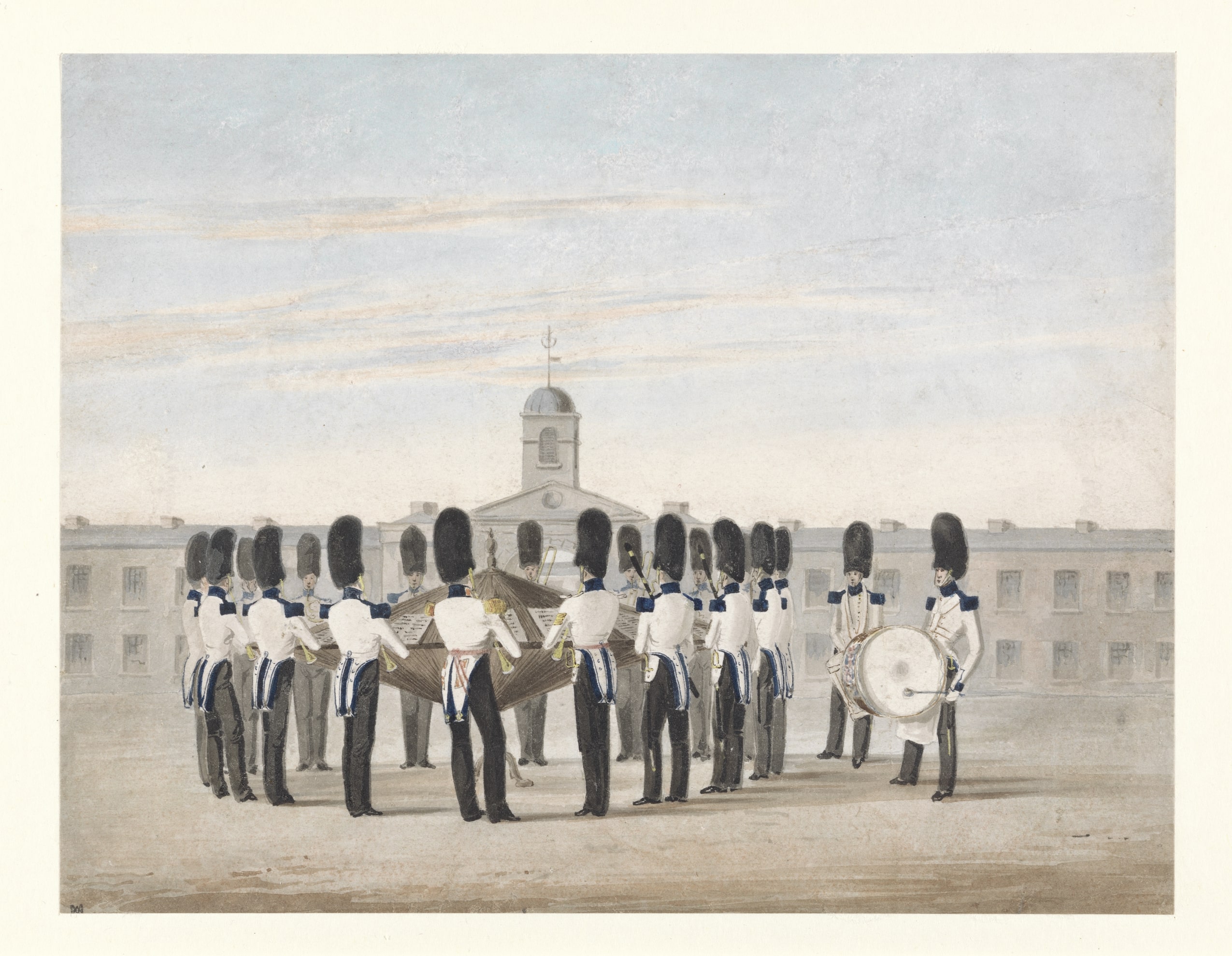
I figured I would share this beautiful 1838 watercolour by Michael Angelo Hayes, now held in the collections of the Yale Center for British Art. The depiction dates from a few decades after my main period of interest, but is a lovely image that I thought was worth sharing. The wooden music stand is an especially interesting feature, and a reminder of the sort of investments made by army officers to enhance their regiment’s musical offering. The setting is Kilkenny Barracks in Ireland. Now known as James Stephens Barracks, it is still used by the Irish Defence Forces. I was lucky enough to be given a guided tour of the place in the autumn of 2018.
Update: an article contexualizing the Tomlinson diary excerpt is now available to read in the journal Historical Research. The passage has also been republished alongside my critical commentary in Sexual and Gender Difference in the British Navy, 1690–1900, ed. Seth LeJacq (Routledge, 2024), 272–5.
Today’s been a busy day for me so far: it began with an interview on BBC Radio Four’s Today Progamme and has since then been packed with media correspondence and calls, interspersed with much-appreciated messages from friends.
The reason for all the hubbub is my discovery of a passage from the 1810 diary of Yorkshire farmer Matthew Tomlinson, which I uncovered quite by chance in Wakefield Libraries. Reflecting on news reports of the execution of a naval surgeon for sodomy, Tomlinson suggested that homosexuality is innate and should not be punished by death. While the farmer was still prepared to countenance penalties in at least some circumstances, his comments indicate that more understanding attitudes towards human sexuality were circulating in British society more widely – and at an earlier date – than is commonly assumed. It seems especially fitting to share this find in February, the UK’s LGBT History Month.
On 14 January 1810, Tomlinson wrote: “it appears a paradox to me, how men, who are men, shou’d possess such a passion; and more particularly so, if it is their nature from childhood (as I am informed it is) – If they feel such an inclination, and propensity, at that certain time of life when youth genders [i.e. develops] into manhood; it must then be considered as natural otherwise, as a defect in nature”. Either way, “it seems cruel to punish that defect with death.” This inference sparked solemn religious introspection, as Tomlinson struggled to understand how a just Creator could countenance such severe penalties for a God-given trait: “It must seem strange indeed that God Almighty shou’d make a being, with such a nature; or such a defect in nature; and at the same time make a decree that if that being whome he had formed, shou’d at any time follow the dictates of that Nature with which he was formed he shou’d be punished with death.”
Speaking with Claire Pickering (Wakefield Libraries) and Sean Coughlan (BBC News) last week in Wakefield.
Wakefield Local Studies, 920:TOM, Journals of Matthew Tomlinson of Doghouse Farm pp.1049-1050 – 14 January 1810: “Was this week sencibly affected in reading the behavior, and execution of a Mr Dixon Taylor, surgeon on board the Jemaica [sic] Westindia-man for an unnatural crime: a man of great genious, and a ready turn of wit: it appears a paradox to me, how men, who are men, shou’d possess such a passion; and more particularly so, if it is their nature from childhood (as I am informed it is) – If they feel such an inclination, and propensity, at that certain time of life when youth genders [i.e. develops] into manhood; it must then be considered as natural otherwise, as a defect in nature – and if natural, or a defect in nature; it seems cruel to punish that defect with death. But if it first takes its rise in the human mind from a viciated, and corrupted inclination; and by cherishing and encouraging such a propensity or inclination it becomes habitual, then it is upon such premises worthy of capital a severe punishment: It must seem strange indeed that God Almighty shou’d make a being, with such a nature; or such a defect in nature; and at the same time make a decree that if that being whome he had formed, shou’d at any time follow the dictates of that Nature with which he was formed he shou’d be punished with death. Now we do not see any symptoms of such a propensity in the brute creation: male invariably seeks the female, and that is the only argument which causes me to think that it is first formed from a visiated [sic] principle. Now as life is very desirous to all animated beings, I think it would be no reproach to the legislative power, were they to mitigate the punishment which is executed upon rapes, and sodomy, from death to casteration [sic]: as I shou’d suppose that if a man was casterated [sic], he wou’d neither have power, or feel inclination to commit such a crime a second time, and he might perhaps become a useful member of society: but when he his [sic] punished with death, we are certain that he cannot do either any more hurt or good; whereas if he was only casterated [sic], it wou’d be equally put out of his power to commit the same evil, and there wou’d be a great possibility of him doing much good.”
I am currently on a train returning from Cambridge, having presented a paper on duelling, honour, and military law at an eighteenth-century graduate seminar yesterday afternoon. I stayed over with a friend last night and consulted a few Napoleonic-era collections this morning at the Cambridge University Library.
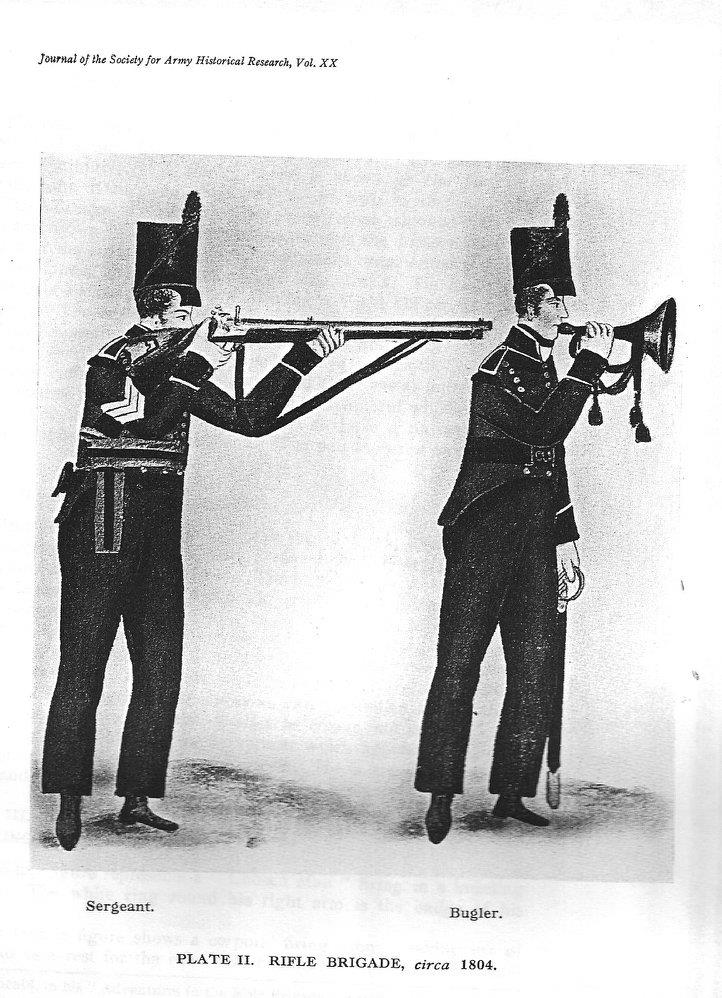
Besides a few welcome anecdotes of duelling officers and military musicians, I chanced on a set of December 1803 inspection reports written by Major-General John Moore, including one for the iconic 95th Rifles. I am not an expert on Moore’s Shorncliffe system or the early years of the 95th, but found the report intriguing as it casts this revered and supposedly revolutionary regiment in a rather unflattering light. Moore took a dim view of most of the officers, decrying their willingness to indulge in ill-considered innovations simply to differentiate themselves from the rest of the army. According to Moore, these ‘eternal changes’ resulted in inconsistent practices and unpolished manoeuvres.
“The five companies of the 95th (Rifle) Regt. are a very active, stout body of men, perhaps the best for service in the Brigade…there is a good military spirit in the corps, to do their duty & to distinguish themselves. A desire to form something quite different from the rest of the Army, without having sufficiently considered, or previously determined in what the difference was to consist, has prevented the Regt. from being formed upon any one system. The eternal changes which have been made, have occasioned inaccuracy in drill, & uncertainty in movement. Lt-Col Beckwith is not an intelligent officer, nor is he calculated to command a light corps, nor are the other field officers I have seen good exercising officers, or expert with their men in the field. Thus, good materials have not been made the most of – but still there are some good officers in the 95th. The non-commissioned officers and men are intelligent, and it is a corps which will be useful, & do its duty upon service.” [signed] Major-General John Moore
Source: Cambridge University Library, Sir John Moore Papers, MS Add.9340/1, Major-General J. Moore to General Sir D. Dundas, 30 December 1803, pp.39-40.
This being New Year’s Eve, I figured I would share an apposite quotation from William Darter’s reminiscences of life in Reading, Berkshire during and after the Napoleonic Wars.
“[I]t was customary on New Year’s Eve for the ringers of St. Lawrence’s parish to ring in a few peals of changes and leave the bells up on their stays, and some short time before midnight to return. At the same time the Militia Band assembled at the upper part of London Street, and all was still, until the moment St. Lawrence’s clock began to strike twelve, when off went the merry peal of eight bells, and at the same moment three loud strokes of the big drum led off the Berkshire Band down London Street to the Market Place, and from thence through a portion of the town. Seventy-one years have elapsed since I first experienced the magic effect of this music of the band and the merry peal of St. Lawrence’s bells breaking out in the stillness of midnight, suggesting that the old year had passed away, and welcoming the dawn of its successor.”
Source: W.S. Darter, Reminiscences of Reading: An Octogenarian (Reading, 1889), p.82. This particular excerpt is dated August 1885, suggesting that Darter first experienced the New Year’s celebrations described above in 1814.
I wish all my friends and colleagues the very best for 2020.
Mass mobilization during the French Revolutionary and Napoleonic Wars, unparalleled in scale and duration, had a significant impact on British musical life. The drastic expansion of the regular army and proliferation of auxiliary corps prompted unprecedented investment in martial musical ensembles, expanding opportunities for ordinary men and boys to acquire instrumental skills while providing all levels of society with greater access to concerted entertainment. Military units of all shapes and sizes scrambled to source appropriate instruments and uniforms, engage competent teachers and identify promising players. Regular and militia regiments combed prisoner-of-war camps for interned black soldiers and sailors willing to take up Turkish percussion instruments while discharged drummers and trumpeters found their musical expertise in high demand among volunteer corps desperate for qualified instructors. Musical instrument makers quickly took advantage of the commercial opportunities created by the expansion of the military market, offering all-inclusive package deals to colonels eager to outfit budding ensembles with the requisite instruments and equipment.
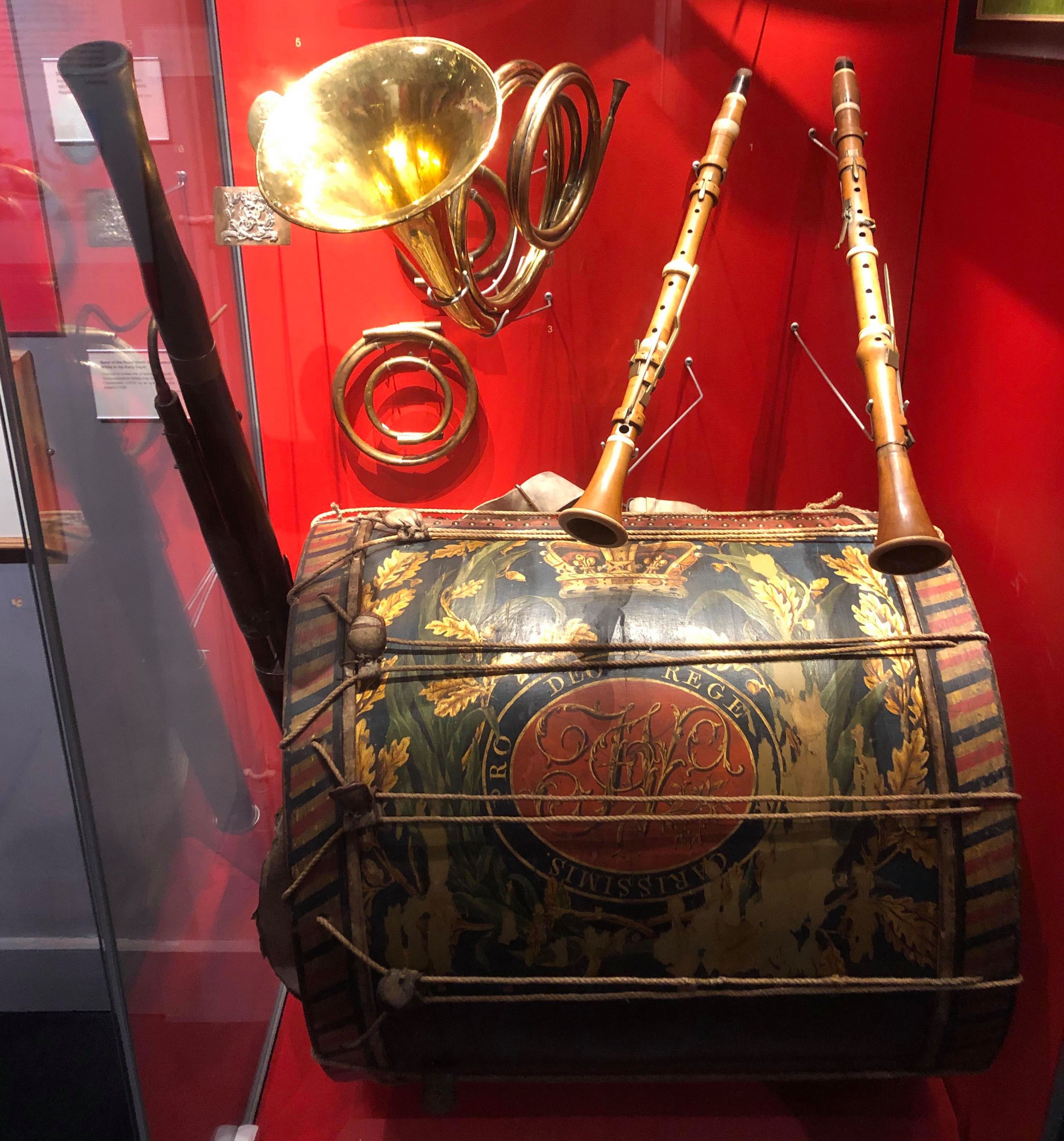
All this effort and investment had a tangible musical impact, of course, training a generation of instrumentalists from plebeian backgrounds, but the Napoleonic-era ‘martial musical project’ also left a significant material legacy. Stray military musical instruments, some boasting dubious Waterloo provenances, can still be found in local and regimental museums, country houses, and parish churches across the UK.
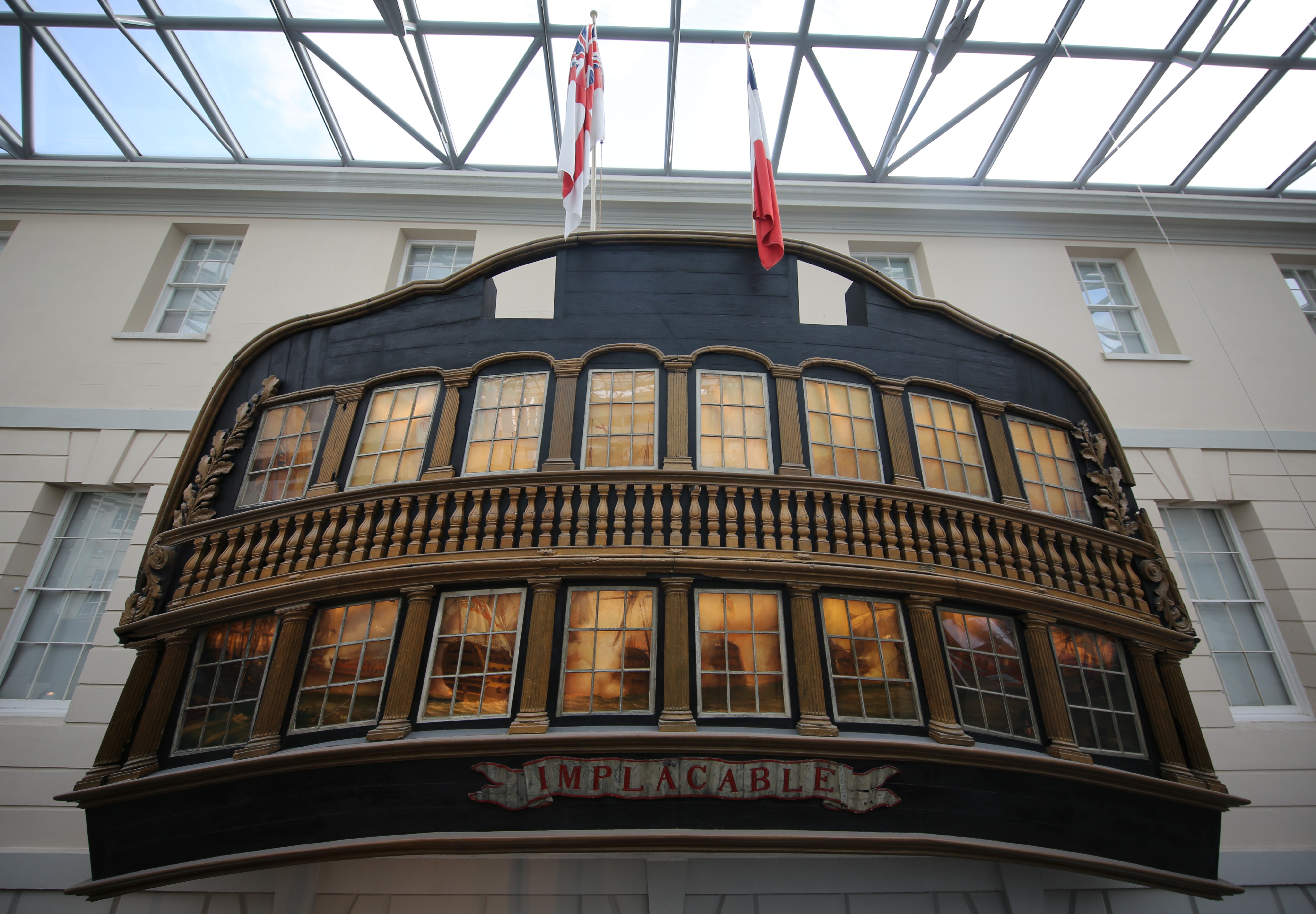
The HMS Victory, preserved in dry dock at Portsmouth, is famous as the sole surviving warship of the Battle of Trafalgar, a critical British success during the Napoleonic Wars and probably the most storied naval engagement of all time. Yet few people remember the battle’s penultimate survivor, HMS Implacable, which remained afloat until the mid-twentieth century.
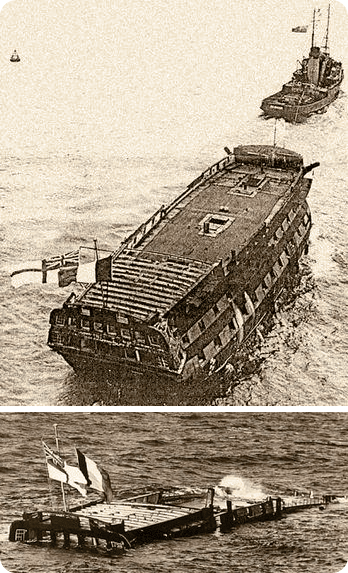
The Pathé newsreel “Implacable to The End” (featured above) documents the scuttling of Implacable on 2 December 1949 in the English Channel. The then-150-year-old warship had started life in the French Navy in 1797 as the 74-gun Duguay-Trouin and fought at Trafalgar on 21 October 1805. Two weeks later, she was captured by the British and renamed Implacable, serving in the Royal Navy for the remainder of the Napoleonic Wars. Withdrawn from active service in 1842, Implacable was retained as a training vessel. By the early twentieth century, the decaying third-rate ship of the line was recognized as an important relic of Britain’s maritime heritage. She benefited from several campaigns, backed by philanthropists and royalty, to fund essential maintenance and save her from being broken up. However, in the context of government austerity following the Second World War, the Admiralty balked at paying for a full-scale restoration, and, despite widespread public outcry, chose to dispose of the wooden warship through a ceremonial burial at sea.
Rigged with explosive charges and weighed down with pig-iron as ballast, Implacable was towed out into the Channel and dispatched with full military honours. As the newsreel’s narrator notes, the ship was scuttled while flying the British White Ensign and the French tricolour – a nod not only to her past service under both flags but also to the twentieth-century reconciliation and friendship of former enemies.
A model of a Napoleonic-era man-of-war appears on screen as the narrator provides a brief synopsis of the HMS Implacable’s storied naval service. This shot allows audiences to imagine the ship in its original splendour – a far cry from the dismasted hulk visible in the newsreel.
The voiceover also makes copious use of naval terminology and metaphor to remind audiences of the ship’s history and Britain’s vaunted seafaring tradition more generally. For instance, the wooden man-of-war, filmed before being towed out to her doom, is noted as being within ‘striking distance’ of the fleet at anchor at Spithead, and ‘within range’ of her successor, the new HMS Implacable (1944). Such language, accompanied by shots of modern battleships, reflects a conscious effort to link the Royal Navy’s past and present.
As the narrator acknowledges, ‘no ceremonial exists’ for such a rare event as ‘the honourable scuttling of a ship’, so the Royal Navy had to improvise, according the vessel ‘honours in keeping with her tradition.’ Thus, before the charges were detonated, the escorting warships cut their engines, honour guards saluted and a bugler played the Last Post. As journalist Neal Ascherson reflected in 2005, the affair was an ‘exquisite episode in Britain’s long practice of inventing tradition and turning truly squalid occasions into pageantry.’[1] HMS Implacable’s solemn state funeral, and the resulting newsreel, celebrated Britain’s naval heritage while destroying one of its most significant artefacts.
According to the narrator, however, Implacable lived up to her name even after her hull had been breached. She sank very slowly, remaining ‘defiant in death’ and ‘refus[ing] to be beaten’, ‘fight[ing] to the last’.[2] This language evokes the stricken vessel’s reputation as a fighting ship. Her demise, audiences are told, constitutes one final battle honour to cap off a storied career. Amidst all the pomp and circumstance depicted in the newsreel, it is easy to forget that Implacable was sunk not by enemy action but by her own navy, a victim of something as prosaic as fiscal austerity.
Written by Eamonn O’Keeffe
Stern of HMS Implacable, now on display at the National Maritime Museum, Greenwich (Wikipedia, Creative Commons)
Today I returned from a lovely vacation to Scandinavia having enjoyed stunning scenery, outstanding museums and (predictably, knowing my interests) some impressive castles and fortifications.
During my travels, I encountered a British 6-pounder field gun at the excellent Danish War Museum in Copenhagen. While the fine detail of artillery design is not my forte, I thought I would share some photographs here for interested friends and followers. The cannon, numbered 1374, was cast by Henry and John King in 1810. It bears the royal cypher of King George III and that of John Pitt, 2nd Earl of Chatham, who was Master General of the Ordnance from 1801 to 1806 and again from 1807 to 1810. The field gun was captured by the Danes from the King’s German Legion at the Battle of Sehested in Schleswig-Holstein on 10 December 1813.





_stern.JPG)