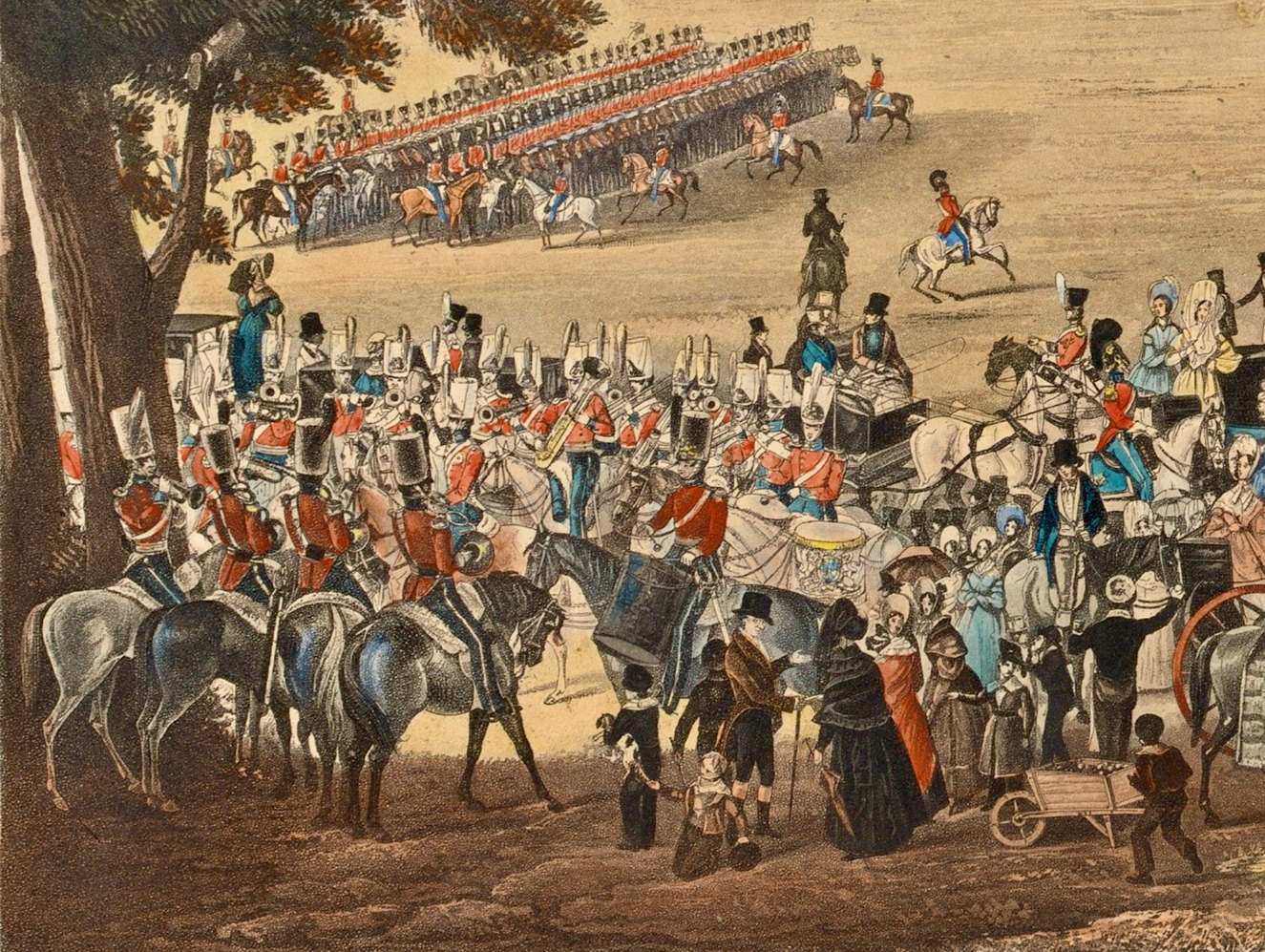
An article of mine, entitled ‘British Military Music and the Legacy of the Napoleonic Wars’, has just been published in The Historical Journal. Drawing on newspapers, memoirs, and regimental records, it examines the implications of wartime military mobilization for British and Irish musical life in the decades after 1815. One part of the article discusses the origins of brass bands, revealing that the first such ensembles in Britain were organised by military regiments after the Napoleonic Wars.
The implications of my research for brass band history received extensive media coverage in Britain earlier this week, including an excellent BBC News feature and articles in newspapers such as The Times. ITV News dreamt up an unbeatable strapline: ‘”War – what is it good for?” – brass bands, according to a Cambridge historian.’ The University’s press team, spearheaded by Tom Almeroth-Williams and Jonny Settle, also crafted an engaging web story (‘Bold as Brass’) and a short film summarising some of my key findings. I am grateful to the Harrogate Band, featured in the video below, for allowing us to record them playing several pieces of music relevant to the research.
Read my article, now freely available via the website of The Historical Journal, for the full story (click here for a PDF).
Abstract
Historians have increasingly stressed the impact of the French Revolutionary and Napoleonic Wars on Britain and Ireland. Less attention, however, has been paid to the legacies of martial mobilization after 1815. Drawing on hitherto unused press and archival sources, this article assesses the implications of wartime military expansion for the music profession, and musical culture more generally, in the decades after Waterloo. It demonstrates that men and boys who honed their instrumental skills in uniform embarked on a variety of civilian musical careers, becoming instructors, wind performers, composers, and even opera singers. The article traces the post-war circulation of regimental instruments and reveals that a multitude of militia and volunteer bands remained active long after demobilization. The wartime proliferation of military bands, moreover, encouraged the subsequent spread of quasi-martial wind ensembles in wider society. Finally, the article proves that brass bands were first introduced to Britain and Ireland in a regimental guise. The influence of the military on musical culture after 1815, in short, was palpable and often profound, and manifested itself in numerous ways and settings.
 1812 and all that