Recently the Journal of the American Revolution (JAR) featured several newspaper advertisements giving descriptions of drummers and bandsmen who deserted from the British army in the Thirteen Colonies during the 1760s and 1770s. These notices, which typically offered a reward for the deserters’ apprehension, also provided unusually detailed descriptions to aid in their identification, reporting physical characteristics, uniforms, accents and even personality traits.
Inspired by the JAR article, I’ve decided to share a few similar advertisements for drummers and bandsmen from the Napoleonic period. It’s worth noting that several of these musicians could play multiple instruments; one (James Crick) had previously worked as a singer at the Royal Circus, a London theatre that staged an eclectic mix of equestrian and musical entertainments. Indeed, musicians were more likely to desert than many unskilled rank-and-file soldiers as they possessed marketable talents which allowed them to make a decent living in civilian life. As one officer stated in 1861: ‘There is no greater amount of desertions in any regiment than from the band; but that is simply because they get a certain amount of musical education which enables them to earn a livelihood, and they go away.’ (Nick Mansfield, Soldiers as Workers, p. 108) While this testimony dates from a later period, the remark appears to have held true of the Napoleonic era as well. One of the deserter advertisements below lists three bandsmen and a drummer who all fled from the East Essex Militia on the same night, suggesting a coordinated plot, while most of the 43rd Foot’s band also deserted during its post-war service in northern France. Similarly, four musicians of the 18th Light Dragoons absconded from Brighton in 1802, with press reports suggesting they had ‘escaped to France’. Given the high proportion of foreign bandsmen employed by the British army, however, it is possible that these deserters were motivated less by Bonapartist fervour than by homesickness. (Bury and Norwich Post, 9 June 1802)
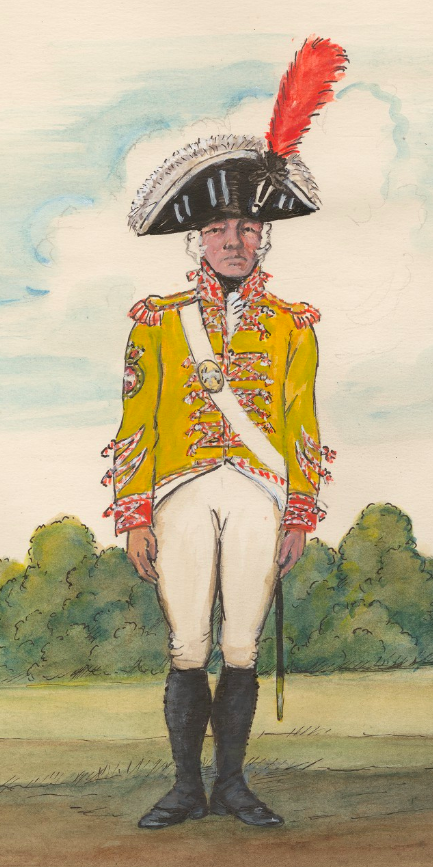
John Murray, trumpeter (and presumably bandsman) of the 23rd Dragoons
DESERTED from the Division of the above Regiment stationed at Lisburn, on the 19th instant, JOHN MURRAY, Trumpeter. Aged about 22 years, 5 feet 9 inches high, fresh complexion, but a good deal freckled, well made, brown eyes, brown hair, round shouldered, by trade a labourer, born at or near Duddington, near Edinburgh – had on when he went off, a plain yellow jacket without laps, black Huzar [sic] cap, white leather bree[c]hes, and black leggin[g]s; he took with him his trumpet, and a clarionet; he sounds the former and plays the latter, both very well.
Whoever will apprehend or cause to be apprehended, and lodge in any of His Majesty’s Jails or Guard-houses, the above-named JOHN MURRAY, shall receive twenty shillings over and above the allowance given by Act of Parliament, by applying to the Commanding Officer at Lisburn, or Messrs. CORRY, BRISTOW & CO., Holles-street Dublin; or Captain JAMESON of the 23[r]d Dragoons recruiting at Glasgow.–Lisburn, June 20, 1800. (Belfast News-Letter, 1 July 1800)
![York Herald (York, England), Saturday, February 22, 1806; pg. [1]; Issue 819 copy.jpg](https://eamonnokeeffe1812.com/wp-content/uploads/2018/06/york-herald-york-england-saturday-february-22-1806-pg-1-issue-819-copy.jpg)
John Massey Tierney AKA Francis Massey, various corps
DESERTED, on the THIRTEENTH February, 1806, from his Majesty’s 21st Regiment of Light Dragoons, at York Barracks,
JOHN MASSEY TIERNEY, aged 23 years, 5 feet 11 inches high, fresh complexion, brown hair, hazle eyes, born at Rathkeal, in the County of Limerick, and by profession a Musician; had on when he deserted a light brown or drab coloured double-breasted coat, black satin waistcoat, blue overalls, hussar boots, white neck-handkerchief, and round hat. He slept at the Tiger Inn, at Beverley, on Friday night, the 14th inst. at which place he left his overalls to defray his expenses. It is supposed he is gone to Hull, as he wanted a Chaise [horse-drawn carriage] from Beverley to that place. He was formerly a trumpeter in the Limerick Fencible Cavalry, and was discharged at the reduction of that Corps; after which he enlisted into the 21st Light Dragoons, married, and purchased his discharge. He has since served in the 16th Light Dragoons, and the 96th Regiment of Foot, from both of which he deserted, and availed himself of his Majesty’s late Proclamation for Pardoning Deserters, and was allowed to join the 21st Light Dragoons.
The following advertisement of the above Man, appeared in “The Hue and Cry,” of the 9th November 1805:
DESERTER – From the 96th Regiment of Foot,
FRANCIS MASSEY, 22 years of age, 5 feet 11 inches high, is handsome and well made, gentlemanly manners, and animated address; had on a blue hunting jacket, single breasted, with white metal buttons, striped waistcoat, brown breeches, German boots, white cotton stockings, black beaver hat, a pea-green silk plaid cravat, and sometimes a white fur inside his cravat.
This man has a strong propensity to lying, is continually talking of having gambled away large sums of money, which has reduced him to his present state; of being nearly related to Lord Clarina and the Massey family of the county of Limerick. Has been in the practice of forging letters of introduction to respectable families for the purpose of obtaining money, by pretending to be a young gentleman who will shortly possess large property; and it is not impossible that he may have recourse to swindling to maintain his imaginary or assumed consequence.
He was formerly a trumpeter in some regiment of dragoons, married a girl in Limerick, who had some money, by which he procured his discharge, and spent the money, was necessitated to inlist in the 96th regiment as a Musician, in which he remained but a few months before he deserted; he was charged at Bristol with having loaded dice in his possession.
He surrendered himself under His Majesty’s Proclamation of the 14th? of October last before a Magistrate [word obscured] to Lieutenant Dawson, commanding a recruiting party of the 2d Battalion of the 62d [Regiment – words obscured], and deserted again on the [date obscured]. (York Herald, February 22, 1806)
Matthew Pollard, Armagh Militia
MATTHEW POLLARD, Musician, aged 22, five feet four inches high, fair complexion, a little freckled, oval vissage, brown hair, grey eyes, slender body, strong limbs, thick ancles [sic] and large feet, remarkable thick lips, rather turning outwards, a particular open between the front teeth of the lower jaw; had on at the time of desertion, a regimental Waistcoat over his Uniform, viz. white Jacket laced with scarlet twist in the Light Dragoon style, Bearskin wings, round buttons, with a black Waist-belt, and [a] high black varnished Cap, speaks affectedly as endeavouring to imitate an English accent.
A Reward of FIVE GUINEAS, over and above his Majesty’s Bounty, will be paid to any Person lodging the above Deserter in any of his Majesty’s Gaols or Guard-houses…
(Belfast News-Letter, 6 November 1807)
Three musicians and a drummer of the East Essex Militia
All four men deserted from Portsmouth on the evening of 21 August, 1811, presumably as a group.
1st. JAMES CRICK is about 30 Years of age, 5 Feet 8 Inches high, very thin make, pale complexion, dark hair, hazle eyes, by trade a watchmaker, born and served his apprenticeship at Norwich, long head and face, very wide mouth and large teeth, aquiline nose, round shoulders, stoops in his walk, has been employed as a singer in the Royal Circus, London some years ago, noted for comic singing, played a bassoon in the band.
2nd. JAMES FULKER is about 23 years of age, 5 feet 8 inches high, straight and well made, fresh complexion, dark brown hair, grey eyes and dark eyebrows, round head and face, short nose, wide mouth, and speaks thick, walks very upright, born at Halstead in Essex, played the octave fife in the band, and plays on the violin.
3d. WILLIAM SMITH is 28 years of age, 5 Feet 10 inches high, stout, well made, fresh complexion, brown hair, gray eyes, light eyebrows, large head and round face, common mouth, broad shoulders, walks very upright, lisps in his speech, born at Halstead in Essex, by trade a woolcomber, played on the trombone in the band.
4th. WILLIAM CARTER, Drummer, is 33 years of age, 5 feet 6 3/4 inches high, stout made, dark complexion, dark brown hair, hazle eyes and dark eyebrows, large head, round face, short thick nose, small mouth, pitted with the small pox, has a scar on the right side of his chin, large square shoulder, proportionable thighs and legs, small feet, steps very quick in his walk, born at Coggeshall in Essex. (Ipswich Journal, 31 August 1811)
James Smith, formerly of the disbanded Royal African Corps
JAMES SMITH, 1st Company, 42 years of age, 5 feet 4 3/4 inches high, stout made, round head, oval face, grey eyes, brown eyebrows, long nose, small mouth, long neck, brown hair, square shoulders, long arms, small hands, proportional thighs and legs, small feet, born in Liverpool, County of Lancaster, by trade a labourer, deserted on the 22d Sept. 1822, from Wynberg [Cape Colony]; he has a wound on the right knee, and plays on the trumpet, bugle, flute, and other musical instruments. (Cape Town Gazette, and African Advertiser, 14 June 1823)