Today I returned from a lovely vacation to Scandinavia having enjoyed stunning scenery, outstanding museums and (predictably, knowing my interests) some impressive castles and fortifications.
During my travels, I encountered a British 6-pounder field gun at the excellent Danish War Museum in Copenhagen. While the fine detail of artillery design is not my forte, I thought I would share some photographs here for interested friends and followers. The cannon, numbered 1374, was cast by Henry and John King in 1810. It bears the royal cypher of King George III and that of John Pitt, 2nd Earl of Chatham, who was Master General of the Ordnance from 1801 to 1806 and again from 1807 to 1810. The field gun was captured by the Danes from the King’s German Legion at the Battle of Sehested in Schleswig-Holstein on 10 December 1813.
Last week I travelled to Canterbury for the excellent Music in Nineteenth-Century Britain conference. I listened to fascinating papers, met some lovely people and presented my own research on the manuscript tune books of Napoleonic-era fifers and bandsmen. I was also managed to fit in visits to county archives on the way to and from the conference – the Hertfordshire Archives on 2 July, exploring the voluminous records of the Hitchin Volunteers and Midland Hertford Local Militia, and the Kent History Centre on 6 July, looking at a variety of documents including letters home from the Peninsula, Lord Castlereagh’s correspondence and papers of Cinque Ports Volunteer officers.
After the conference I spent a day at Walmer and Deal Castles, two artillery forts built by Henry VIII to defend the Downs, a strategically important anchorage off the Kent coast. Walmer was of special interest as it later became the residence of the Lords Warden of the Cinque Ports, a post often held by senior political figures. William Pitt the Younger, the prime minister for much of the French Revolutionary and Napoleonic Wars, spent a great deal of time at the castle as did Wellington, who died there in September 1852.
Walmer Castle
Deal Castle
The chair and room Wellington died in, 1852
Pitt the Younger’s view from the office at Walmer Castle…the Downs and the French coast. Hard to take your mind off the invasion threat here!
In the evening I visited the Western Heights at Dover, a complex of derelict Napoleonic and Victorian defences built to protect the harbour from cross-Channel invasion. Hiking around the Western Heights is not for the faint of heart – visitors are faced with steep inclines, poor signage and overgrown paths, and much of the site is inaccessible – but I found the rather masochistic experience very rewarding. The scale of these fortifications was immense and the views of the surrounding landscape simply breathtaking. Below I’ve posted some photographs of the Drop Redoubt and the ditch connecting it with the (unfortunately fenced-off) Citadel.
Drop Redoubt
Connecting ditch between Drop Redoubt and Citadel
Panorama of Drop Redoubt ditch
I also managed to visit the famous Grand Shaft – a triple helix staircase sunk 140 feet into the chalky Dover cliffs to give soldiers living in the barracks atop the Western Heights speedy access to the harbour below. An impressive feat of military engineering, the Grand Shaft was constructed between 1806 and 1809.
Faced with the prolonged threat of cross-Channel invasion during the French Revolutionary and Napoleonic Wars, Britons bore arms on an unprecedented scale. The army and militia were drastically expanded, while part-time volunteer corps were organized nationwide, with gentlemen, shopkeepers, tradesmen and labourers raising money for uniforms and equipment and sacrificing their spare time to practise military drill. At the height of the invasion crisis in 1804, almost 400,000 Britons were enrolled as volunteers, participating in what John Cookson has termed “the greatest popular movement of the Hanoverian age.”[1]
The significance of volunteering has been the subject of spirited debate among contemporaries and modern-day historians alike. Some have characterized this mass movement as an expression of grassroots support for the war effort and indicative of a burgeoning sense of British national identity. But sceptics have argued many volunteers were merely ‘play-safe patriots’ who enrolled in part-time auxiliary corps for pay or to avoid being balloted for the full-time militia. Contemporaries also expressed divergent opinions about the merits of the volunteers as a fighting force. Critics ridiculed their perceived amateurism and indiscipline, questioning whether such ‘weekend warriors’ would be much use against Napoleon’s Grand Armée in the event of invasion. Others were more optimistic: Lord Cornwallis pronounced in December 1803 that “no man, whether civil or military, will persuade me that 300,000 men, trained as the volunteers at present are, do not add very materially to the confidence and to the actual security of the country.”[2] That same month, Lt.-Col. Isaac Brock, commanding the 49th Foot at Fort George in Upper Canada, recorded his satisfaction on learning of the Duke of Northumberland’s efforts to arm and train his tenants: “It is pleasing to hear of the exertions of men of such amazing influence as their energy must diffuse itself to all around. I now look upon England as placed beyond a possibility of danger.”[3]
But a series of pamphlets authored by Bryan Blundell in 1799 provides a more pessimistic portrayal of the volunteer movement. A former private in the 1st Battalion of Liverpool Independent Volunteers (LIV), Blundell had been drummed out for denigrating the corps in an anonymous letter to the Sun newspaper in September 1798. He had characterized the LIV as poorly equipped and badly led, calling for the dismissal of its incompetent and “republican” officers.[4] The latter epithet referred to the Whig politics of Captains Thomas Earle and Joseph Birch, for Blundell considered their conspicuous opposition to Pitt’s ministry and openness to peace with France as evidence of “avowedly republican” principles.[5] After being expelled from the corps as punishment for aspersing the patriotism of his commanders, Blundell published several pamphlets decrying his summary dismissal and chronicling the faults of his former unit, which had been rendered “completely ridiculous” (in his telling) by the squabbling, ineptitude and questionable loyalty of its officers. In Blundell’s second polemic, The Rise, Progress, and Proceedings, of a Corps of Volunteers, shewing how Thirty Republicans have endeavoured to make Five Hundred Loyal Gentlemen Truly Laughable… (1799), he ridiculed the mismatched equipment and inconsistent drill of the LIV’s seven companies, singling out the drummers for particular contempt. “There were about eight drummers and eight fifers belonging to the battalion, and, strange to tell, they were habited in seven different uniforms — “Risum teneatis, Amici!”” The italicized Latin phrase translates as: “Friends, can you help but laugh?”
Image courtesy of Google Books and the British Library
Blundell’s Rise, Progress, and Proceedings was complemented by a striking caricature, “Symptoms of Uniformity in the Drummers of an Independent Corps!!” The clothing and equipment of the LIV’s motley crew of ‘sheepskin fiddlers’ vary markedly in both design and hue, as do the facial expressions, ages and even ethnicities of the drummers themselves. The print depicts an assortment of headgear, ranging from cocked hats to bearskin caps, while the shoes and legwear of several drummers are shown to be in tatters. Indeed, if the colouring can be trusted, two drummer are not wearing any trousers at all. Of course, the veracity of this humorous and grotesque depiction is unclear: as a disgruntled ex-volunteer, Blundell had every reason to exaggerate the discordancy of the drummers’ appearances for comic effect. Yet whatever the accuracy, the artist clearly paid some attention to detail: several of the drums appear to be emblazoned with the Royal Arms, but two sport a design incorporating sun rays, fasces crossed with a liberty cap, and a liver bird, a symbol of the city of Liverpool.
Blundell went to great lengths to publicize the perceived injustice of his dismissal from the LIV, complaining he had been “drummed out of a Corps of Volunteers for [his] Loyalty”. The tenacious pamphleteer raised his case at the Court of King’s Bench, corresponded with William Windham, the Secretary at War, and sent two copies of his tract to the Duke of York, the Commander-in-Chief of the Army. Blundell even managed to hand his pamphlet, with the “caricature annexed”, to George III while the King was “getting on horseback” at the gate of one of the central London parks in April 1799.[6]
For all his efforts, however, Blundell’s campaign for redress evidently came to nothing, and it has so far proved impossible to corroborate or debunk his criticisms of the LIV, which were unquestionably coloured by personal and political animus. Yet Blundell’s vendetta against the Liverpool Independent Volunteers has bequeathed posterity not only a further example of tension between domestic party-politics and ‘national defence patriotism’ during the French Wars, but also an arresting image – surely deserving of recognition as a superlative visual critique of the volunteer movement.
[1] A. Gee, The British Volunteer Movement, 1794-1814 (Oxford, 2003), p.2; J.E. Cookson, British Armed Nation, 1793-1815 (Oxford, 1997), p.66. [2] R. Knight, Britain against Napoleon: The Organization of Victory, 1793-1815 (London, 2014), p.270. [3] Library and Archives Canada, RG 8 ‘C’ Series, vol. 513, p.115, Lt. Colonel Isaac Brock to Major James Green, Military Secretary, 22 December 1803. The Duke of Northumberland organized his tenantry into the Percy Tenantry Volunteers, commanded by his son, Lord Percy. [4] “Volunteering–New and Old”, Dublin University Magazine (July 1859), vol. 54, pp. 68-70. [5] [B. Blundell], The Rise, Progress, and Proceedings, of a Corps of Volunteers, shewing how Thirty Republicans have endeavoured to make Five Hundred Loyal Gentlemen Truly Laughable… (London, 1799), p.5; B. Blundell, Four letters for the consideration of all loyal Britons; and particularly for the attention of all loyal volunteers, shewing how republicans act when in power, and what underhanded meanness they are guilty of (1799), p.4. [6] [B. Blundell], Dancing Masteriana, or Biographic Sketches for an inquisitive public; being the true style of a dancing master…to which are added five letters…, (London, 1799), pp.19, 23, 25, 30.
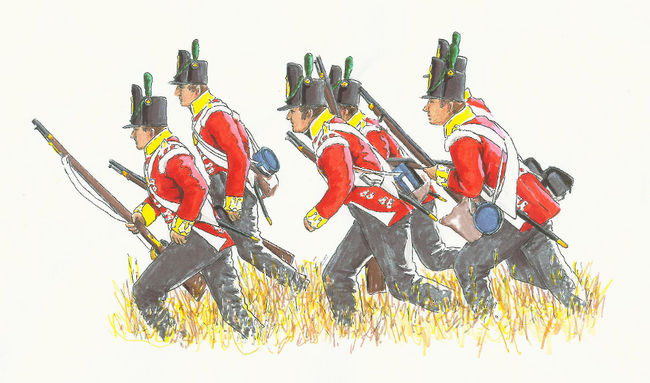
6th (1st Warwickshire) Foot, Light Company (St. Catharines Standard)
Over the past few years, I have repeatedly encountered evidence of non-light infantry formations in the Napoleonic-era British armed forces practising skirmishing manoeuvres. During the same period, the bugle, commonly associated with the light infantry, began to supersede the drum as the favoured instrument for issuing musical commands even in some line regiments. These developments demonstrate the army’s ability to innovate and adapt to the practical demands of warfare, as it had previously done in the Seven Years and American Revolutionary Wars.
I recently came across another example of the use of light infantry tactics outside the light infantry proper in an unexpected place – the Home Office papers chronicling post-war radical reform disturbances – and thought I would share it on this blog.
In the aftermath of the failed April 1820 Grange Moor rising in West Yorkshire, the 6th (1st Warwickshire) Regiment of Foot under Lieutenant-Colonel Archibald Campbell was dispatched to the area to overawe would-be rebels. In a letter written to his superior on 23 April, Campbell included the following aside:
‘On the moor, my people [6th Foot] are out frequently, either all together as a small Batt[alio]n, or two companies at a time practising light movements, having always accustomed my Batt[alio]n companies to act when necessary “en tiraileurs”.’[1]
The word ‘tirailleur’, of course, was a contemporary French appellation for light infantry skirmishers.
Archibald Campbell exchanged into 6th Foot in 1812, commanding the 1st Battalion during the Peninsular War and later in Canada during the closing months of the Anglo-American War of 1812.[2] Despite the letter’s post-war date, his phrasing indicates that the regiment’s battalion companies – and not just its solitary light company – had been instructed in skirmishing tactics during their previous years of active service.
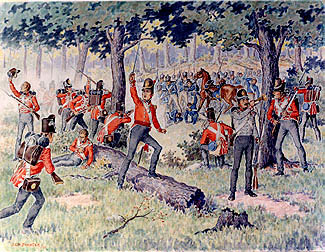
However, even if non-light infantrymen received some light infantry training, there was always the risk of miscommunication when employing unfamiliar bugle calls. At Maguaga in the Michigan Territory during the War of 1812, the 41st Foot Grenadiers managed to snatch defeat from the jaws of victory by misinterpreting a bugle command at the climax of the engagement.
A twentieth-century depiction of the Battle of Maguaga by J.C.H. Forster (Windsor Public Library) – note the 41st Foot bugler at right.
Thomas-René-Verchères Boucher de Boucherville (1784-1857) recalled the blunder in his journal: “At the appointed moment, with the two ranks face to face, Major [Adam] Muir ordered the bugler at his side to sound the bayonet charge. Just then the company of grenadiers of the 41st commanded by Captain Bullard [Bullock], which General Procter had sent to reinforce us, came up. We were not at all sorry to see them for things were getting decidedly hot for us… The grenadiers, who had been sent by the General to reinforce us, were stationed in the centre. The signal which Major Muir was to give for the charge had not been explained to them, and thinking it was an order to retreat, they turned to the rear without firing a single shot… Finally, we were obliged to draw back because of the unexpected and groundless retreat of the grenadiers and that, too, at the very moment of victory, for the enemy’s centre had broken…the grenadier company, in place of helping us, succeeded only in throwing our ranks into disorder and was the sole cause of our defeat. This is painful to say, yet it is the simple truth.”[3]
[1] UK National Archives, HO 40/12, f.320, Letter to Maj-Gen Sir John Byng from Lt-Colonel Archibald Campbell, dated Leeds, 23 April 1820. [2] Further details of Campbell’s varied career can be found in his 1839 United Service Journal obituary. [3]War on the Detroit: The Chronicles of Thomas Verchères de Boucherville and the Capitulation by an Ohio Volunteer, ed. M.M. Quaife (Chicago, 1940), pp. 96-98.
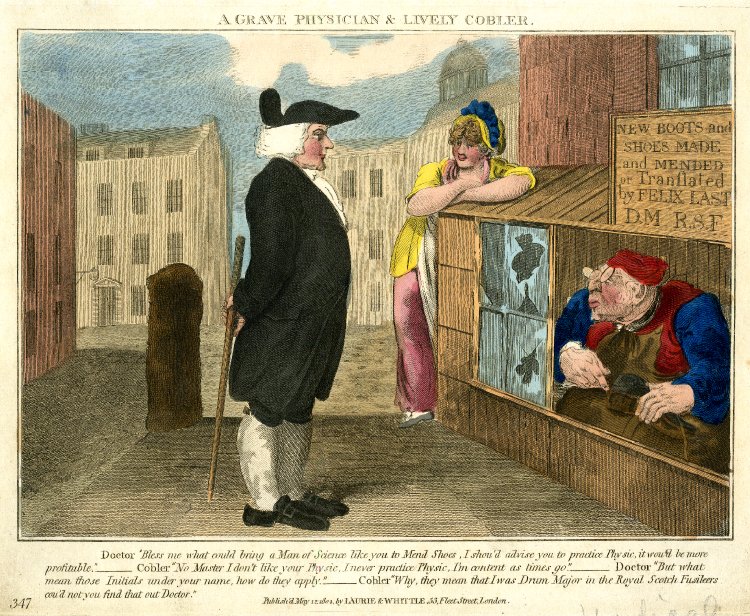
In the 1804 London satirical print, ‘A grave physician & lively cobler’ (pictured above), a doctor humorously mistakes humble tradesman Felix Last for a Fellow of the Royal Society. Eyeing the post-nominals emblazoned above the cobbler’s booth – D.M. R.S.F. – the perplexed physician asked the bespectacled cobbler ‘what could bring a man of science like you to mend shoes[?]’ The doctor urged Last to put his education to ‘more profitable’ use by taking up a medical career, prompting the shoemaker to clarify that he knew nothing of ‘physic’; the initials actually signified his former service as a drum major in the Royal Scotch Fusiliers.[1]
Another version of this anecdote appeared in The Gentleman’s Magazine in July 1809. As a correspondent calling himself Cacafogo (Spanish for braggart or fire-sh*tter) complained: ‘so universal is the mania for self-dignification, that, some time ago, in one of my ambulatory excursions, passing through a village in Wales, I observed painted on a board in front of a raccomodeur’s [clothes-mender’s] stall…“Solomon Sheers, M.B.M.D.M.A.” I own my astonishment was roused, and my curiosity keenly excited, at seeing these indiciæ of academical honours, so inapplicable to [the] appearance of the bode and its inhabitant, and therefore easily sought a solution to the enigma; when the knight of the thimble courteously informed me that it denoted him to be a breeches-maker, and also drum-major to the Anglesea Militia.’[2]
According to the disapproving correspondent, the tailor-cum-drum-major’s generous helping of post-nominals was symptomatic of a wider scourge of social climbing, with vulgar parvenus putting on airs and eroding what he considered to be the natural order of society.
Of course, the satirical names employed in both the print and the magazine submission cast doubt on the anecdote’s veracity. ‘Cacafogo’ aside, ‘Solomon Sheers’ presumably alludes to the scissors essential to a tailor’s trade, while Felix Last’s surname surely references the wooden forms used by shoemakers. But fact or fiction, the joke – simultaneously lampooning academic pretensions and ridiculing drum-major-cobblers for getting too big for their boots – enjoyed lasting appeal. A very similar story was recounted by Thomas Geering (1814-1889) in his 1884 reminiscences of nineteenth-century life in Hailsham, Sussex: ‘Here is another trade joke. A facetious cobbler, who had been a soldier, and settling down in one of our small towns in the neighbourhood, put on his board over his shop-door following his name, “F.R.S.” Soon after he was visited by a stranger, a gentleman, who, offering his hand, feelingly inquired how it happened that a Fellow of the Royal Society should be found in so humble a position; but the man readily explained that he knew nothing of the Royal Society nor its letters. He had only, he said, initialed his last profession as Fifer in the Royal Surrey [Militia], and as he hoped the letters would attract attention and bring him customers, he did not feel disposed to alter the sign.’[3]
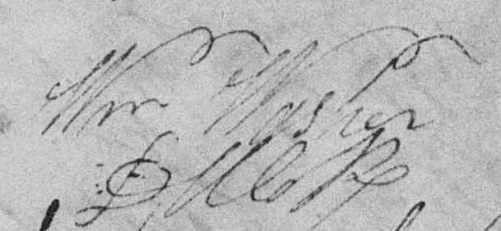
Whatever the truth of these amusing stories, they certainly capture the considerable pride taken by Napoleonic-era veterans in their wartime service, be they seasoned Peninsular men or former weekend warriors of the local volunteers. Moreover, I know of one verifiable (if rather more melancholy) instance of a drum-major appending the initials of his rank to his signature. Drum-Major William Washer of the Canadian Fencibles attended the 1812 funeral of James Faulkner, the three-month-old son of a black regimental bandsman, and signed his name as a witness in the Sorel parish register as “Wm Washer DMCR” – Drum-Major, Canadian Regiment.
Christ Church Anglican, Sorel (Lower Canada) parish registers, 3 December 1812
[1] Strictly speaking, no regiment of this title existed during the early nineteenth century. The Royal Scots Fusiliers were then known officially as the 21st (Royal North British Fusilier) Regiment of Foot, North British being a synonym for Scottish.
[2]The Gentleman’s Magazine (July 1809), p. 608. The anecdote was repeated in The Cambrian newspaper on 26 August 1809: “In the front of a tailor’s shop, in North Wales, is a board with this dignified inscription: – “SOLOMON HUGHES, B. M. M. D. M. A.” which the owner interprets, Breeches Maker and Drum Major to the Anglesea Militia.”
[3] T. Geering, Our Parish: A Medley, by one who has never lived out of it (Lewes, 1884), p. 87.
Faced with the existential threat of Revolutionary and Napoleonic France, Britons bore arms on an impressive scale between 1793 and 1815, with more than one in five able-bodied men in full- or part-time service by 1805. The expansion of the regular army and proliferation of auxiliary corps generated unparalleled demand for military musicians, providing boys and young men from humble backgrounds with new opportunities to develop musical skills. Many veterans of this wartime ‘musical armed nation’ became professional performers, composers and music instructors after discharge, enriching cultural life in the United Kingdom and the wider British empire.
Examples of civilian musicians who began their careers in the armed forces are legion (and the topic of much of my PhD research). This article opens by examining the life of one such martial minstrel, John Sinclair, to illustrate the legacies of Napoleonic-era mass mobilization for British musical culture before exploring the military connections of other nineteenth-century musical celebrities.
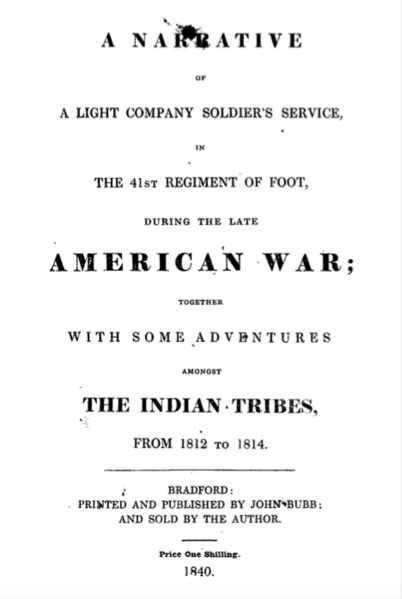
For a number of years, I have been interested in the life of Shadrack Byfield (1789-1874), a Wiltshire-born soldier of the 41st Foot known his 1840 memoir, A Narrative of a Light Company Soldier’s Service, which chronicles his experiences during the War of 1812. But Byfield’s adventures certainly did not end with the amputation of his left forearm following a wound suffered at the Battle of Conjocta Creek in 1814. Among other post-war escapades, he secured the patronage of Sir William Napier (the famed Peninsular War historian), published a second memoir detailing his religious conversion, and (allegedly) ripped open an adversary’s eye and face with his iron hook prosthesis during an 1853 riot over predestination in a Gloucestershire Baptist chapel.
My research on Shadrack Byfield will hopefully result in a book in due course, but this brief blog post, written to coincide with the anniversary of the Battle of Lundy’s Lane, explores the somewhat less colourful life of William Buckman, the light company bugler repeatedly mentioned in Byfield’s writings. By coupling this testimony with information gleaned from Buckman’s army pension record, we can gain insight into the life of one early nineteenth-century ‘musical warrior.’
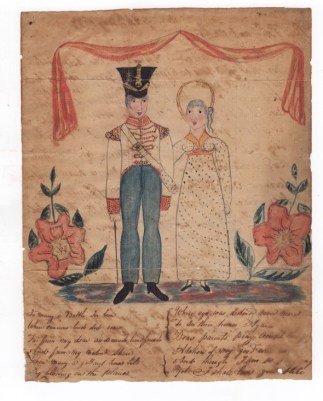
Portrait of 41st drummer and wife, Madras, 1823 (Chris Bryant Collection, courtesy René Chartrand)
William Buckman was born circa 1797 in Bath, a famous spa town in the southwestern English county of Somerset. He enlisted in the 41st Foot’s newly-formed 2nd Battalion, headquartered at Winchester, on 16 September 1812, aged approximately fifteen or sixteen. The following year, the 2/41st was sent out to British North America to reinforce the regiment’s 1st Battalion, which had served in the Canadas since 1799.
William Buckman’s first (and only) experience under fire was at the Battle of Lundy’s Lane on 25 July 1814, the bloodiest engagement ever fought on Canadian soil.[1] The 41st’s light company, commanded by Captain Joseph Glew, joined the confused contest after nightfall, but were scarcely able to tell friend and foe apart in the darkness. The light company’s two buglers (William Buckman and John Stott) presumably played a critical role in transmitting orders in action, and in one case appear to have spared their comrades from the brunt of an American volley. According to Byfield, on encountering an unknown regiment on the battlefield: “The [company’s] guide positively asserted that it was one of the enemy. Our bugle then sounded for the company to drop. A volley was then fired upon us which killed two corporals[2] and wounded a sergeant and several of the men. The company then arose, fired, and charged. The enemy quitted their position; we followed and took three field pieces.”[3]
As Byfield’s account suggests, the 41st light company’s bold charge recovered, albeit only temporarily, the captured British guns at the centre of the battlefield.[4] Yet Glew’s daring gambit came at a cost for Buckman, who was injured in the right arm. Byfield seemingly alluded to the bugler’s wounding in an alternative account of the Battle of Lundy’s Lane included in his shorter 1836 memoir: “We came at once to a charge,—and although the two corporals on my right were killed, and the trumpet knocked from the trumpeter’s mouth, the enemy retreated…”[5]
Buckman’s right forearm was amputated near the elbow joint; he spent time in hospital but was deemed ‘unfit for further service abroad’ and was sent home to England in autumn 1814. The bugler’s discharge papers, signed by 41st Lieutenant-Colonel William Evans, described Buckman as a ‘Gallant Soldier’ with ‘a very Good character’, certifying his eligibility for a pension. These documents also provided a basic physical description: Buckman boasted hazel eyes, black hair and a brown complexion, was only 5’1” in height and was classified as a labourer – a catch-all occupational category for soldiers without a specific trade.[6]
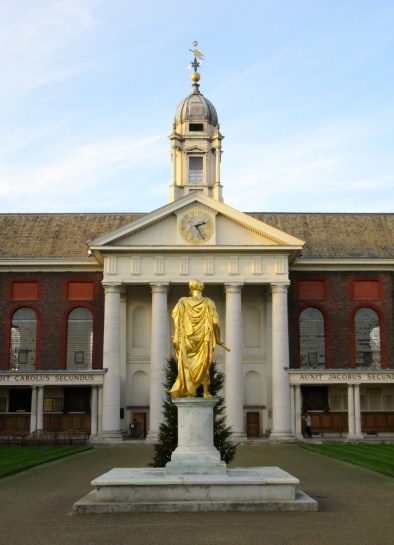
Royal Hospital Chelsea
Buckman was sent to the Invalid Depot at Chatham in Kent, where he awaited a hearing before the Royal Hospital Chelsea’s Board of Commissioners, who determined the pensions awarded to wounded soldiers on leaving the army.[7] But as Chelsea was overwhelmed by a backlog of injured and incapacitated servicemen returning from overseas campaigns, Buckman was not called before the Board until 8 August 1815, when he appeared alongside ten other 41st invalids, including Shadrack Byfield.[8]
Byfield specifically noted Buckman’s case when recalling his own Chelsea hearing in his 1840 memoirs: “My feelings were much excited, that day, on learning that our bugle-horn man, who was a young soldier, who had been but in one action, and had lost a fore arm, about the same length as mine, was rewarded with one shilling per day. I must say, that I felt very much dissatisfied with nine pence…”[9]
William Buckman’s entry in the Royal Hospital Chelsea’s Out-Pension Admission Books (TNA, WO 116/19)
Byfield, a battle-hardened veteran, clearly felt slighted that the young, inexperienced Buckman had been awarded a more generous pension, echoing the complaints of other soldier-memoirists like Thomas Jackson or William Lawrence, who accused the Chelsea commissioners of both parsimony and caprice. To be fair, however, their wounds were not exactly comparable, for Buckman had been deprived of his right forearm while Byfield had lost his left. Assuming both men were right-hand dominant, it was arguably reasonable for the Chelsea board to consider Buckman’s injury the greater loss. Nevertheless, Byfield was convinced he had been shortchanged and doggedly pursued the increase he believed he was owed until finally granted the full shilling two decades later.
As for Buckman, nothing is known of his post-war life. He died on 16 March 1833, aged 36, and was buried five days later at the Church of St Mary the Virgin in Bathwick, a suburb of Bath.[10]
[1] Buckman was presumably joined at Lundy’s Lane by the light (No. 6) company’s other bugler, John Stott. See The National Archives, UK (TNA) , WO 12/5416, 41st Pay Lists. [2] The two corporals killed at Lundy’s Lane were Benjamin Morris, a weaver from Blackburn, Lancashire, and Thomas Seville, a labourer from Amesbury, Wiltshire. See TNA, WO 12/5416, 41st Pay Lists, and WO 25/1768, 1769, 41st Casualty Returns. [3] Shadrach Byfield, Narrative of a Light Company Soldier’s Service (Bradford, 1840), 48. [4] John Le Couteur, Merry Hearts Make Light Days, ed. Donald E. Graves (Montreal, 2012), 175. For a wider discussion of the Battle of Lundy’s Lane, and debate over which side controlled the guns at the close of the engagement, see Donald E. Graves, Where Right and Glory Lead! The Battle of Lundy’s Lane, 1814 (Montreal, 1997). [5] Shadrach Byfield, ‘Two Years’ Service of a British Soldier’, United Service Journal, Part II (London, 1836), 508. [6] TNA, WO 97/569/19, discharge papers of William Buckman. Here and elsewhere, Buckman is ranked as a drummer, a term used by contemporaries to refer to fifers and buglers as well as drummers. Buckman’s service in the light company, coupled with Byfield’s reference to him as ‘our bugle-horn man’, prove that he served as a bugler. [7] TNA, WO 12/12061, Depots &c Andover, 3. [8] TNA, WO 116/19, ‘Examination of Invalid Soldiers on Tuesday the 8th of August 1815’. [9] Byfield, Narrative of a Light Company Soldier’s Service, 54. [10] TNA, WO 120/25, 41st Foot pensioners; Somerset Archives, Bathwick St Mary parish registers (accessed via Ancestry.com), 1833 burials, page 3. Buckman was buried on 21 March 1833. He was living in Burlington Place, Walcot (a Bath suburb) at the time of his death.
British military musicians helped boost morale and stave off boredom both on campaign and in garrison. But music also had an important medical purpose, especially on transoceanic voyages, as soldiers wasted away in cramped, suffocating conditions below decks for months at a time. Open-air dances and promenades were regularly held on the quarterdeck, invariably accompanied by music, to provide soldiers with much-needed fresh air and exercise. The 2/1st Royal Scots band were ‘often requested’ to perform as men danced on deck ‘for the benefit of their health’ en route to India, while soldiers bound for the Caribbean spent their evenings dancing hornpipes and reels accompanied by fifes and bagpipes.[1] During an 1817 voyage from Calcutta to St Helena, the band of the 1/66th Foot offered a concert ‘every fine evening’ followed by a dance on the quarterdeck – ‘a most salutary amusement on board ship,’ according to Assistant Surgeon Walter Henry, ‘where exercise is so much needed.’[2] In the 1/45th, which spent nearly eighteen months at sea in 1806 and 1807, fifers and drummers on the Hercules transport were ordered to ‘play half an hour to each company’ as the men kept in shape by parading ‘round the decks’ twice daily.[3]
View from the Deck of the Upton Castle Transport, of the British Army landing on Isle de France (Mauritius), 1810
Officers also relished musical entertainment at sea. Sixteen-year-old Dunbar Moodie, a 2nd Lieutenant in the 2/21st, recalled his voyage to Holland in 1813 aboard the HMS Nightingale: ‘To add to our comforts, we had the regimental band with us, who were generally playing through the day, when the weather or sea-sickness would allow them.’[4]
When transports travelled in convoys, military musicians aboard one vessel could entertain soldiers on neighbouring ships. An officer returning to England in 1812 recalled how the East Indiaman carrying the 33rd Foot’s musicians ‘would occasionally range up alongside [our transport], and give us an air… We also took advantage of the band to knock up a dance now and then.’[5]
Sergeant Stephen Morley of the 5th Foot suggests that instrumental performances were routine aboard the Atlas transport during an 1806-7 voyage to South America via the Cape of Good Hope: ‘It was usual for the band to assemble every morning on the poop.’ But military musicians were no match for fickle weather conditions; multiple accounts describe performances being cut short when storm clouds gathered. According to Morley, the 5th’s band was once forced to disperse due to sudden strong winds, resulting in a humorous episode involving an unfortunate serpent-player –
Serpent player, 3rd Guards Band, 1811
“Henry Rogers, one of the band, whose instrument was a serpent, sat down, as the gale increased, on the quarter deck, holding on by a cleet to secure himself. The ship now laboured excessively, and on a sudden giving a lurch, brought her gun-wales under water, and caused Henry to drop the serpent and let go his hold: away they went, chasing each other from side to side, at every heave of the vessel, without the possibility of stopping. Such of the officers and men who for security, were holding on by the capstan, laughed heartily at this singular chase; such a one, as the St. Leger annals could never boast of.[6] One of these gentlemen losing his hold followed against his will in this curious gambol, and added to the merriment of his companions.”[7]
[1] R. Butler, Narrative of the Life and Travels of Serjeant Butler (3rd edn, Edinburgh, 1854), 62-3; J. Patterson, Adventures of Captain John Patterson (London, 1837), 388-9. [2] [W. Henry], Trifles from my Portfolio (2 vols, Quebec, 1839), I, 202. [3] S. Brown, Wellington’s Redjackets:The 45th (Nottinghamshire) Regiment on Campaign in South America and the Peninsula, 1805-14 (Barnsley, 2016), 15. [4] A. Bamford (ed), Triumphs and Disasters: Eyewitness Accounts from the Netherlands Campaign, 1813-1814 (Barnsley, 2016), 145. [5] J. Blakiston, Twelve Years’ Military Adventure in Three Quarters of the Globe… (2 vols, London, 1829), II, 116-7. [6] The St Leger Stakes is an annual English horse race which began in 1776. [7] S. Morley, Memoirs of a Sergeant of the 5th Regt. of Foot, Containing an Account of his Service in Hanover, South America, and the Peninsula (Ashford, 1842), 20-2.
The Battle of York is among the best-studied episodes in Toronto’s early history. Two centuries on, new information about this dramatic and traumatic event continues to emerge.
Drum Major of a Regiment of the Line &c. Courtesy R. Chartrand
In a recent article for The Napoleon Series entitled Fops under Fire, I explored the experiences of British drum-majors in action during the early nineteenth century. These princes of pomp and circumstance were often ridiculed for their battlefield truancy, and indeed drum-majors were not expected to risk their skins by actively participating in combat. Rather than leading the band in stirring renditions of patriotic music under fire, most drum-majors occupied themselves with unglamorous yet essential tasks behind the lines, from aiding the wounded to haranguing would-be shirkers. However, a handful of brave (or reckless) drum-majors refused to confine themselves to such unadventurous auxiliary roles and were instead celebrated for their valour under fire.
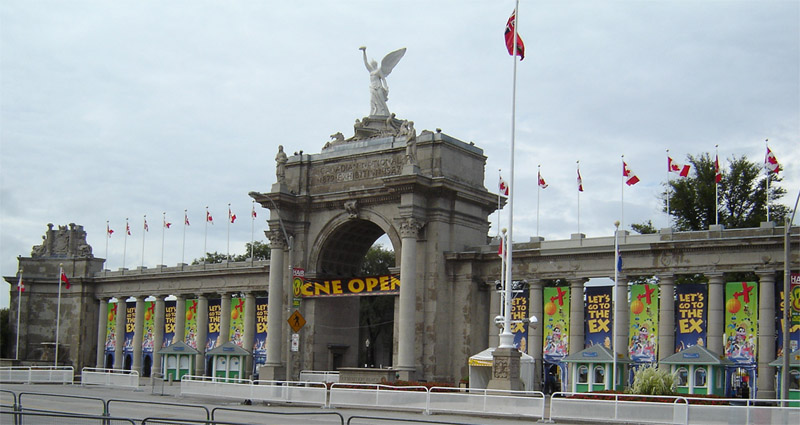
One newly-discovered instance of drum-majorly daring took place at the Battle of York during the War of 1812. Having failed to check the invading American army on the beach or in the clearing at Fort Rouillé on 27 April 1813, the British fell back to the Western Battery near the site of the modern-day Princes’ Gate at Toronto’s Exhibition Place. Supported here by three artillery pieces, the defenders hoped to make a stand against the advancing enemy column. However, the accidental explosion of a portable powder magazine within the battery caused mayhem, dismounting all but one of the British cannons and killing or maiming dozens of men. The guns were abandoned as the enemy drew near, but according to an anonymous eyewitness account, in the form of an 1833 letter to the editor in the U.S. Military and Naval Magazine, the “gallant Drum Major of the 8th or King’s Regiment” returned in “full costume” to the stricken battery. At the very moment of “raising the linstock” to fire a parting shot from the remaining 18-pounder into the advancing American column, this “brave soldier” was brought down by a skilled rifle shot from Second Lieutenant David Riddle of the 15th U.S. Infantry. The drum-major was captured but was treated with “marked attention” in hospital on account of his courage and happily made a full recovery.
Princes’ Gate, Exhibition Place, Toronto
Yet regimental pay lists prove that the drum-major in question was not William Ankers of the 8th King’s, who was also present at the battle, but Thomas Kelly of the Royal Newfoundland Regiment. The American confusion is, however, understandable given that the two corps, both royal regiments with blue facings, sported near-identical uniforms. Kelly, born at St. John’s in Newfoundland and approximately twenty-five years of age at the Battle of York, first joined the army in 1798 and had served for a dozen years as a drummer before his appointment as the regiment’s drum-major. Described as having grey eyes, brown hair, and a fair complexion, he was wounded and taken prisoner at the Battle of York but was soon released in a prisoner exchange. Kelly served as drum major until the Royal Newfoundland Regiment was disbanded in 1816.
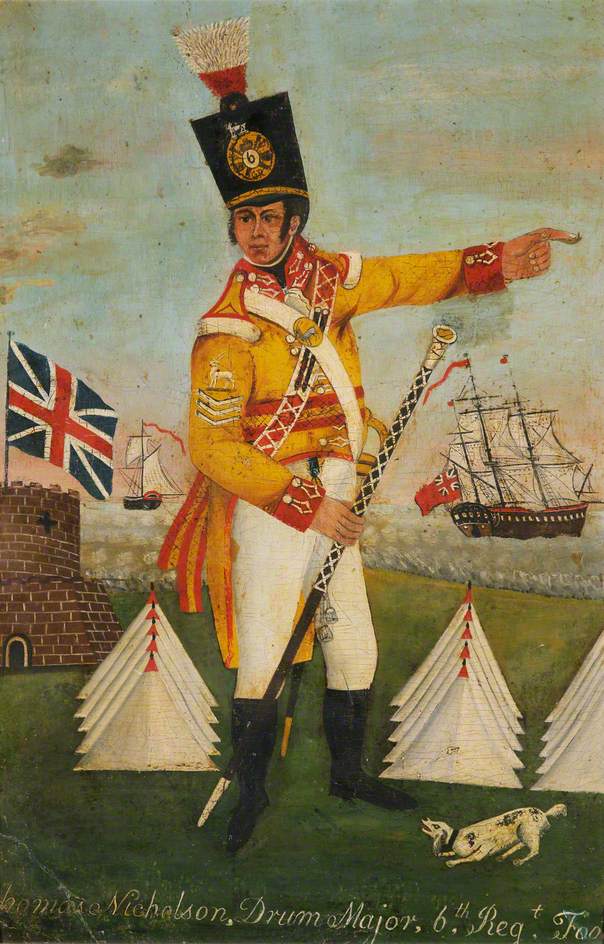
Drum Major Thomas Nicholson, 6th (Warwickshire) Regiment
Although the American correspondent claimed that “no one who witnessed the occurrence will forget” the sight of Drum Major Kelly’s fall, no other accounts of his battlefield bravery have been found to date. Even if Kelly had managed to fire a parting shot from the Western Battery, it probably would not have wrought much damage as the artillery piece was aimed too high to inflict serious injury on the advancing enemy column. Indeed, another American eyewitness recalled that the round shot fired from this gun failed to do more than clip the tops of their pikes and bayonets.
Nonetheless, the heretofore unsung bravery of Drum-Major Kelly during the Battle of York is worthy of our belated recognition. Although some drum-majors may have made themselves scarce under fire, as the sneers of contemporary memoirists suggest, Kelly proved himself worthy of his office and regalia on the battlefield as well as on the parade square.
Researched and written by Eamonn O’Keeffe
“Thomas Kelly: A Drum-Major at the Battle of York” was first published in the Fort York Fife and Drum in September 2016
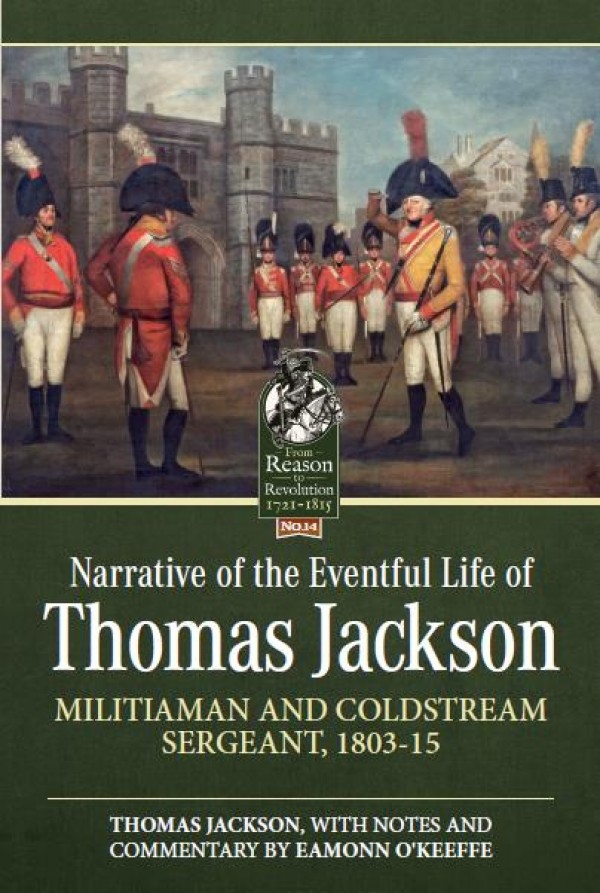
As some visitors to 1812 and all that may already know, I recently edited the Napoleonic-era memoir of Sergeant Thomas Jackson, who served with the Staffordshire Militia at Windsor Castle before losing a leg in the botched 1814 storming of Bergen-op-Zoom with the Coldstream Guards. The Eventful Life of Thomas Jackson was published by Helion & Co in March 2018 and is available both online and in some book shops.
In this blog post, I figured I would share Jackson’s description of life in Windsor barracks. Anthologized in Roy Palmer’s classic Rambling Soldier (1977), this passage offers a vivid reconstruction of the daily routine of early nineteenth-century redcoats:
“As I have promised to tell the soldier’s life in his barrack, suffice it briefly told. Some barracks are very comfortable, and others are not so. The best I ever saw were those at Windsor; a palace compared with many others. Windsor barracks will hold about eight hundred men; the building is four stories high. The rooms are spacious; those on the ground floor take in two companies of men, probably ninety each, rank and file. The sergeants have separate rooms. The men’s rooms serve for mess, sitting, and sleeping rooms. Below (same size) is their cleaning room. The sleeping rooms each hold twenty-nine beds. The attics were appropriated to married soldiers. The rooms were kept remarkably clean and rubbed bright. Drum beats to rise at six in summer, and turn out. Each bed is folded, and sheets and blankets also laid in neat folding pleats. Knapsacks are neatly packed, and hung on pegs over the bed. The arms stand in a rack by the bedside. It was pretty to see the neatness and uniformity of these rooms. But, by the bye, no breakfast is got for the soldier at nine: the mess-drum beats at twelve. When I first went there I used to think that drum the most joyful music I ever heard. The mess was half a pound of boiled meat per man, a can of broth, and a pound of bread; he might either eat it or save it for supper. Two cooks cut out each man’s mess on a coarse brown plate. An officer attends to see all seated at table, and a corporal, pointing to a mess, will ask, “Who shall have this?” A man, with his back turned, replies – naming one.[1] Perhaps a bony mess will sometimes fall to the lot of an unlucky hungry one, when any thing but pleasant looks are shewn; however, the pump makes up the deficiency. Now the dinner drum and fife always played the tune of “O the Roast Beef of Old England,”[2] but it was “all gammon,” for I never tasted a bit of roast till the Jubilee, at the cost of “the good old king.”[3] After dinner – romps, foolish talk, and corrupting each other. Tattoo beating at nine. All in barracks, and roll call; every man standing at his bed, and his name on the foot. The full pay of a private is one shilling and a penny per day, to find him meat, drink, washing, shirts, shoes, stockings, and sundry other things. The diet was well adapted to keep us from growing too corpulent and inactive.”
To find out more about Thomas Jackson’s Narrative, check out my blog post on the publisher’s website.
[1] This messing procedure was meant to ensure fairness, giving every man an equal chance of receiving a choice or gristly cut of meat. See for instance Richard Holmes, Redcoat: The British Soldier in the Age of Horse and Musket (London, 2001), p. 281. [2] The tune ‘The Roast Beef of Old England’ was written by Henry Fielding for his play The Grub Street Opera, first performed in 1731, and was adopted by the British Army as the ‘Dinner Call’ played by fifers and drummers to summon soldiers for their early afternoon meal. See, for instance, Samuel Potter, The Art of Playing the Fife… (London, 1817), p. 16. [3] King George III’s Golden Jubilee, held on 25 October 1809, celebrated the beginning of the monarch’s fiftieth year on the throne.